How is this a surprise? How many times do we have to watch companies put the wrong person in the wrong job? Bob Swan was a rock-star CFO and the wrong person to lead a technical design-focused company like Intel. At Intel, the “E” in CEO stands for Enable. They need someone who can understand and enable their real job: technical design – someone like former CTO Pat Gelsinger. Gelsinger needs to re-enter Intel focused on rebuilding its technical design mojo. That could be his organizing concept.
Remember the difference between generalists and specialists. Generalists focus less and less on more and more until they eventually exert no influence and impact on everything. Specialists focus more and more on less and less until they eventually exert maximum influence and impact on nothing. Either taken to its logical extreme is useless.
Different people at different times in different situations need to play at different points on the specialist-generalist continuum – but never at the extremes.
There are a set of general leadership qualities that all CEOs should have. And then different CEOs need to have particular strengths in line with their organization’s overarching strategy.
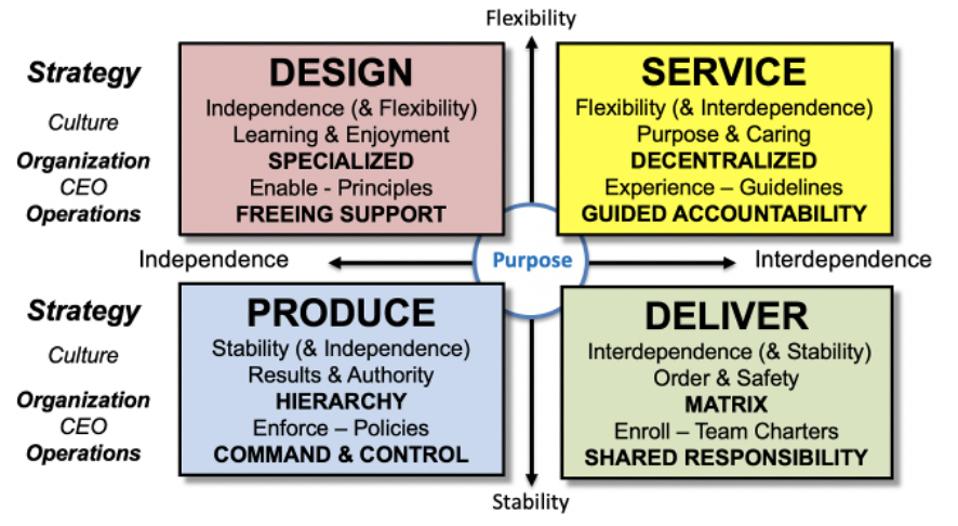
Over-arching strategy
BRADT
- Design-focused organizations need chief enablers, leading with providing principle-based freeing support to relatively independent designers.
- Production-focused organizations need chief enforcers, leading with policies and a hierarchical command and control approach driving stability and consistency.
- Delivery-focused organizations need chief enrollers, pulling in people across the matrix and ecosystem to work interdependently with shared responsibilities.
- Service-focused organizations need chief experience officers, leading flexible, decentralized organizations with guided accountability.
Don’t read this wrong. Every organization has to design, produce, sell and market, deliver, and service. The most successful focus on being best in class in one area and then either world class, strong or good enough in the rest.
- Best-in-class – superior – top 10%
- World class – parity – top 25%
- Strong – above average
- Good enough – the bare minimum acceptable or outsourced
CEOs own direction and culture. They have to breathe the mission, vision, and strategy from every pore. Their personal, individual character has to epitomize the collective character or culture of the organization. Everything communicates. Everything they say and do and don’t say and don’t do get scrutinized by everyone. This is why their organizing concept is so important.
An organizing concept is the strategic core idea being executed in a slogan, message and communication points. Those with stronger beliefs in their organizing concepts find it far easier to stay on message. They’re always communicating what they themselves believe and not reading PowerPoint slides or Post-It notes provided by others.
Think be-do-say. No one believes what a new CEO says. They believe what the CEO does. But if the CEO or any leader’s actions match their words, but don’t match their underlying beliefs, they will trip up.
Thus CEOs’ organizing concepts must match their underlying beliefs and their organization’s overarching strategy.
- Design-focused CEOs have to talk about the power of design and designers.
- Production-focused CEOs have to preach the power of discipline and consistency.
- Delivery-focused CEOs need to think and talk in ways that make others want to join the crusade.
- Service-focused CEOs must think, eat, breath, sleep and talk customer-first always.
Swan couldn’t do that at Intel. He was a financial expert, trained and experienced in seeing how money flows and making process improvements in those areas.
Gelsinger can do that. He’s lived the power of technical design and designers.
Implications for you
If you’re recruiting a new CEO, make sure you’re looking for one that fits your overarching strategy. Now that you’ve read this far, there’s no excuse not to.
If you’re looking at a new leadership role, make sure you’re the right person for the job and that your talent, knowledge, skills and experience will give you the ability and credibility to get people to follow you.
And, if you’re going into a new role, manage your message. It’s the second main idea to accelerate success and reduce your risk in a new job. You’re going to get positioned in your new role – by yourself or others. You are far better off choosing how you want to be positioned and then thinking through and grounding yourself with an organizing concept that is right for your new situation, organization and self.
Click here for a list of my Forbes articles (of which this is #682) and a summary of my book on executive onboarding: The New Leader’s 100-Day Action Plan.