





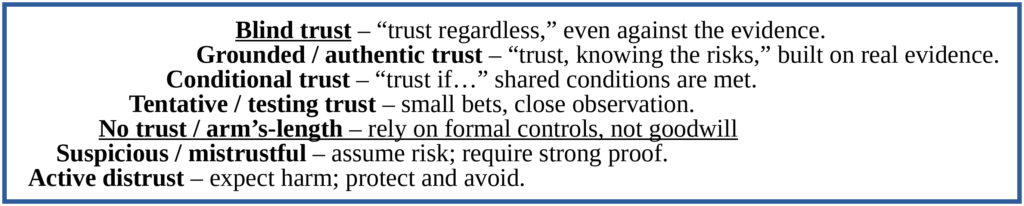
Executives rarely start new roles with real trust. Before day one, most organizations hold new leaders at arm’s‑length, relying on resumes, references, and search‑firm vetting instead of firsthand experience. The first 100 days are the passage from that arm’s‑length non‑trust to grounded, authentic trust—or, if things go badly, into suspicion and even active distrust.
Before Day One: Arm’s‑Length Non‑Trust
Long before the offer letter is signed, people begin forming an impression of the incoming executive. But what they have is not trust; it is risk‑management wrapped in politeness.
- Boards and hiring managers rely on formal controls—interviews, assessments, background checks, contracts—because they cannot yet rely on lived experience of how you behave when it matters.
- Future peers and direct reports develop stories about you based on fragments: LinkedIn, rumors, signals from the search process. At best, this is arm’s‑length non‑trust: they neither expect you to hurt them nor to help them, and they are not prepared to bet their careers on you yet.
The danger for new leaders is confusing selection with trust. Being chosen means you have permission to start; it does not mean people have already decided to follow you.
Days 1–30: Tentative / Testing Trust
Once you arrive, people start running experiments. They place small bets on you, watch closely, and adjust their stance, often unconsciously.
- Early stakeholders extend tentative trust by giving you information, access, and low‑risk decisions; in return, they look for evidence that you listen, learn, and keep your word.
- Every interaction becomes a test: Do you show up prepared? Do you own your mistakes? Do you credit others? People are willing to trust in small, reversible ways but keep their options open in case you disappoint them.
In this phase, speed kills. Move too fast to “put your stamp” on things and you burn through tentative trust faster than it can be created. Move deliberately—asking other‑focused questions, publishing a clear learning agenda, and signaling humility—and you turn tentative trust into something more durable.
Imperative Workshops: From Testing to Conditional Trust
The big step change usually comes with your first “imperative workshop” or equivalent—those designed sessions where you align on the mandate, strategy, operating model, and ways of working with your team and key stakeholders.
- Done well, these workshops create conditional trust: people believe you will act in reliable, predictable ways as long as clearly understood conditions hold—shared goals, transparent metrics, explicit decision rights, and agreed consequences.
- The process itself matters as much as the output. When people see you integrate their input, sharpen the strategy around “must‑win” battles, and translate intent into concrete commitments, they start to trust that you will do what you say—provided the agreed rules of the game are respected.
At this stage, trust is still “trust if.” They trust you if you keep communicating, if you stick to priorities, if you protect them when they take risks in service of the new agenda. Break those conditions and trust evaporates quickly.
Days 30–100: Grounded / Authentic Trust (If Things Go Well)
If you use the first 100 days to deliver a few early, other‑focused wins while living the promises made in those workshops, conditional trust can evolve into grounded, authentic trust.
- Grounded trust rests on repeated experience: people have seen you handle pressure, conflict, bad news, and trade‑offs without sacrificing your principles or theirs.
- The visible markers include: more candor in meetings, faster decisions with less escalation, greater willingness to share bad news early, and lower reliance on formal controls because informal confidence has grown.
This is when the flywheel really starts to spin. The more consistently you align what you be (values and intent), what you do (decisions and behaviors), and what you say (narrative and promises), the more people choose to trust you in bigger, more consequential ways.
When Things Go Less Well: Suspicion, Mistrust, Distrust
Of course, the same 100 days can push the trust trajectory in the opposite direction. The same tests still happen; they just lead to very different conclusions.
- If people experience gaps between what you say and what you do—moving goalposts, hidden agendas, visible self‑protection—they shift from conditional trust to suspicion or mistrust: they assume higher risk and require stronger proof before cooperating.
- If they feel actively harmed—public blame‑shifting, broken promises around roles, or perceived ethical shortcuts—relationships can slide into active distrust, where stakeholders expect damage and begin to protect themselves, work around you, or quietly plan for your exit.
The hard truth: most failed onboardings are not about competence; they are about trust. Leaders try to change too much, too fast, without first earning the right to lead people there—and the organization’s immune system responds accordingly.
For executives, then, the first 100 days are not just about learning the business and setting direction. They are about deliberately moving others along the trust spectrum—from arm’s‑length non‑trust to grounded trust—through every choice in how you listen, decide, communicate, and take responsibility when the inevitable early mistakes occur.
And, of course, this works in reverse too.