





What happens to the organization when you’re not in it?
That question drives Ron Bogart’s leadership fable, A Heartbeat Away: How Strong Organizations Outlast Strong Personalities. One character wakes from open-heart surgery and sees leadership differently. Another is thrust into the CEO role in a sudden crisis. Together they raise a question every leader should answer before a crisis answers it for them.
My article on clarifying nested leadership roles with the BRAVE framework maps four leadership levels to four BRAVE drivers, Behaviors, Relationships, Attitude, and Values all set within a changing Environment. It tells you who owns what. Bogart asks whether it still works when you’re gone.
Codify the operating system
Bogart’s core distinction: “A plan is something you execute. A system is something that operates, whether you’re there or not.” His prescription is to codify the system so it is explicit, written, taught, agreed upon, and repeatable. Without that, most organizations “aren’t running a system. They’re just holding meetings.”
Here is how that applies at each nested level, all within the Environment/context and where to play choices:
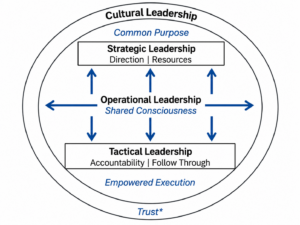
CULTURAL leadership: Who we are and what matters and why (CEO.) This is rooted in Values and is a core part of what the McChrystal Group (MG) calls Common Purpose grounded in Trust in others’ intentions, competence, and consistency.
STRATEGIC leadership: Arranging resources before deployment (Senior Leaders.) This about Attitude/how to win choices and the creation and allocation of the right resources to the right place in the right way at the right time – Direction/ Resources
OPERATIONAL leadership: How to connect, communicate, and build trust across business units and functions (Operational Leaders.) The heart of this is Relationships and Shared Consciousness (MG).
TACTICAL leadership: Deploying and adjusting resources in real time (Front-line Supervisors.) This is about Behaviors, implementation, impact, and Empowered Execution (MG) – Accountability/ Follow-Through
Cultural Leadership – Values: Make “who we are” explicit
Cultural leaders define who we are. Bogart warns about what happens when that stays implicit. The outsider who steps in during a crisis “didn’t just step into a role. They stepped into a vacuum.” They don’t know the unwritten rules or carry the institutional memory. Culture only survives transitions when it has been made explicit.
Action: Write down the values and the decision rules behind them. Teach them, and get agreement on them.
Strategic Leadership – Attitude: Provide context and frameworks, not conclusions
Strategic leaders make the “how to win” choices. Bogart’s advice is to stop being the answer and start providing the context and frameworks. Move from deciding to telling others how to decide. Set boundaries without conclusions and principles without prescribing outcomes.
That means resisting speed for its own sake. Speed is a real advantage, but it also keeps judgment centralized. Bogart asks what conversations speed helps us avoid, and what never gets developed because it takes longer than deciding for someone.
Bogart told me, “Speed itself isn’t necessarily the problem. Rather, leaders who consistently make decisions for others may create and achieve short-term speed at the expense of developing organizational judgment. Ultimately, the goal is to build an organization capable of making good decisions quickly without depending on a single individual.”
Action: Before you answer, ask which principle should guide the answer.
Operational Leadership – Relationships: Name your standbys and understudies
Operational leaders coordinate across functions, business units, programs, campaigns and the like, so this is where dependency hides. Bogart’s answer is the standby: a visible, named, discussed backup for critical roles. Standbys aren’t replacements. They’re signals of where continuity matters and where development is required.
They also solve a quieter problem. Right people in the wrong seats stay there because moving them feels dangerous with no coverage. Standbys create options to develop talent without waiting for a vacancy and to move people where they fit best. If naming a standby feels politically risky, Bogart suggests that may be information worth paying attention to.
Action: For each critical role, ask whether there is a visible, acknowledged standby or understudy ready to step in temporarily or permanently.
Tactical Leadership – Behaviors: Start small
Tactical leaders act in the moment, so this is where habits show up. Bogart’s first moves require no grand plan:
- Speak last in meetings where you normally decide.
- Ask how decisions were made, not just what was decided.
- Make readiness visible, even if imperfect.
- Pay attention to where people wait instead of lead.
A strong signal that you’re functioning as the operating system isn’t that things fall apart without you. It’s that they hesitate. As Bogart puts it, “We deferred until you got back.” He also underlined the point by noting “the distinction between an organization that falls apart without its leader and one that simply hesitates. Dependency doesn’t always announce itself through failure.”
Action: Notice where people wait. That’s where the role isn’t clear enough to act on.
Bringing it together
Run Bogart’s closing question at all four levels: If I were unavailable for six months, what would the organization learn to do, and what would it be unable to do without me?
Where the answer is “hesitate,” you’ve found the level that depends on you. Clarify that role, codify it, and name who stands by it. Then keep going. You’re not trying to disappear. As Bogart says, you’re trying to become less necessary.