






[Note this article is for those helping leaders onboarding into new roles. It’s the other side of the coin from last week’s article for the new leaders themselves: Hot Landings: Starting A New Leadership Role During A Crisis.]
Onboarding a new leader well requires aligning the organization around the need for the new leader and their role, and then acquiring, accommodating, assimilating and accelerating them. It’s challenging under normal circumstances as 40% of new leaders fail in their first 18 months. In a crisis, you need to be much more disciplined and deliberate each step of the way.
Align
Start by thinking through how the crisis is going to impact your organization. Is it major or minor and temporary or enduring? Though, even if it’s temporary, you can use it as the platform to accelerate changes you should make anyway.
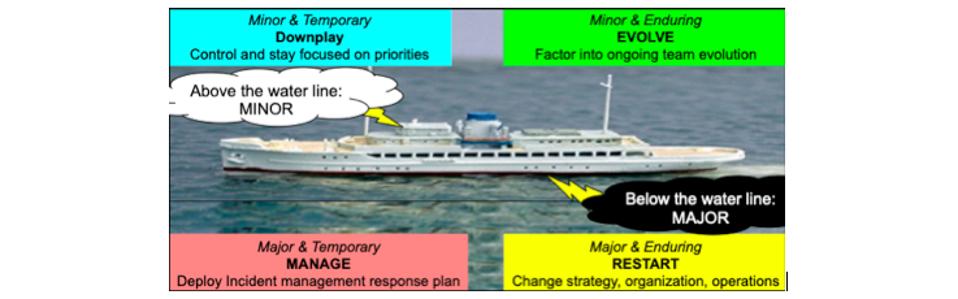
Incident Management
BRADTIn a crisis, your new leader will be making a hot landing. This makes getting alignment particularly tricky. Maslow’s hierarchy resets for everyone. All existing leaders and employees’ first questions go to their own and loved ones’ safety.
What you’ll hear is “How can we add people when we’re about to lay people off?”
What they’re really asking is “Am I safe?”
Your communication about this – and everything in a crisis – should be emotional, rational and inspirational.
- Emotional: Be authentic, relatable and vulnerable as you empathize with how the crisis is affecting them personally and the importance of keeping them and all safe.
- Rational: Lay out the hard facts and possible impacts of the current situation.
- Inspirational: Paint an optimistic view of the future and how this new leader can help all get to that future.
Your objective is to convince all that adding this new leader is in their own best interest. (If you can’t make that happen, either the new leader or some of the current employees or leaders should not be part of the organization’s future.)
Acquire
You can’t pretend to be one type of organization facing one set of circumstances while recruiting people and then surprise your new leader when they show up. Respect the people you’re recruiting by laying out the hard facts of your current situation. If it’s not for them and they’re not for you, it’s in everyone’s best interest to figure that out as soon as you can in the recruiting process.
Play this out at every step of sourcing, recruiting, interviewing, evaluating and closing or not closing the right sale in the right way with the right new leader.
Accommodate
Make sure the new leader can do real work day one. Always important. Even more important in a crisis. You can’t afford extra baggage in a crisis. Every tool you bring with you, every person you bring with you has to help the cause every step of the way.
So, help them put in place their own personal 100-day or 100-hour action plan. Get them set up physically or virtually so they can jump in to help on day one.
Assimilate
Even in a crisis, you need to enable your new leader to work with others. In a crisis, compress the timeline by helping them connect with people even before their first day and setting them up to be helpful on day one. This is about task clarity as opposed to role clarity. Give them something to do – with others – that makes an immediate contribution. Yes this is trial by fire. But set it up so the “trial” builds everyone’s confidence in the new leader.
A second priority in assimilating is learning. The bad news is that no one has the time to invest in teaching your new leader anything in a crisis. On the other hand, everything is new for everyone. Everyone’s learning. Help your new leader learn with others.
Accelerate
The ABCs of management apply: Antecedent – Behavior – Consequences. Don’t expect anyone to do what you hope they will do unless you prompt the desired behavior and then reward it while punishing undesired behavior.
Leaders onboarding in a crisis should move from I) doing what they’re told to II) providing input to III) making recommendations to IV) making decisions. Prompt their transitions from stage to stage, pointing out when they go too fast or slow and encouraging them when they get it right – which they will with your help.
Click here for a list of my Forbes articles (of which this is #629) and a summary of my book on executive onboarding: The New Leader’s 100-Day Action Plan.