As described in my earlier article on What It Takes To Accelerate Through A Strategic Inflection Point, if there is a change in your situation or your ambitions, you need to jump-shift your strategy, organization and operations all together, all at the same time. There are four primary areas of strategic focus: design, produce, deliver, and service. The choice of strategic focus dictates your organizational and operational choices.
This article is the fourth of four and will take you through how to win with a service-focused strategy. The other three focus on design, production, and delivery.
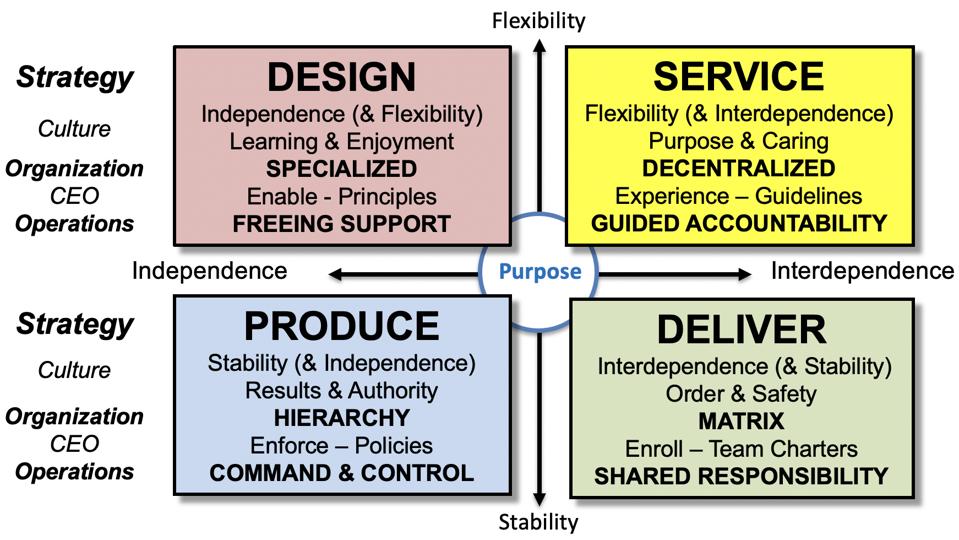
POI Framework
BRADT
Service is ultimately about how you make your customers feel. Design, production and delivery matter. But they only matter as platforms on which to build the experience.
Value is defined as the customer’s view of the relation between your perceived relative benefits and your perceived, relative costs.
- Design-focused organizations win by imagining new valuable things.
- Production-focused organizations win by making valuable things out of disparate elements.
- Delivery-focused organizations win by conveying valuable things from one party to another.
- Service-focused organizations win by valuably enhancing their customers’ experiences.
While most organizations do some level of design, production, delivery and service, and all must market and sell, the most successful organizations have a clear focus on one of the first four areas.
Service Culture
A service-focused organization’s main cultural driver should be flexibility. The front-line people interacting with customers must have the flexibility to meet their needs and exceed their expectations on the spot. Interdependence matters because the front-line people will need to leverage the rest of the organization to help customers. Purpose and caring matter a great deal in uniting all around customer service. But flexibility should rule.
Decentralized Organization
Decentralized organizations work especially well in service-focused organizations. This is inextricably linked to flexibility. Drive decision-making as close to the customer as possible.
The fundamental difference between a decentralized organization and a matrix organization is control of resource allocation decisions. In a matrix organization the geographic or customer-facing people share decisions with functional leaders. E.g. the Florida state manager and national marketing manager must agree on the Florida advertising spend. In a decentralized organization, the geographic or customer-facing people make their own decisions, like the Florida advertising spend.
This makes for faster, more flexible, more customer-experience focused decisions.
CEO as Chief Experience Officer
In an organization basing its success on its ability to create superior experiences for its customers, the CEO has to be the Chief Experience Officer. The Chief Experience Officer owns the vision and the values. They must live customer experience in everything they say, do, and are. If they don’t fundamentally believe, they will get caught.
Just as Ben Hunt-Davis and his teammates evaluated every choice with the question, “Will it make the boat go faster?” on their way to Olympic Rowing Gold in 2000, the Chief Experience Officer should evaluate every choice with the question, “Will it improve customers’ experience?”
Operate with Guided Accountability
Great customer service organizations operate with guided accountability. Everyone holds themselves accountable for how they make each and every customer they come in contact with feel.
Clear guidelines are critical. Think Goldilocks. Policies – mandatory, definite courses of action that all must follow – are too strict. Principles – ways of thinking about action – are too loose. Guidelines – preferred courses or methods of action that all should generally follow – are just right, freeing people up to act in the best interest of the customer with the guidance they need to make decisions on the spot.
If you’re leading a service organization, both parts of guided accountability are critical to effective decentralization. Decentralizing without guidance is abrogating your authority. Guidance without accountability turns the guidance into theoretical gibberish. Only by letting people take up true accountability for the customer experience within agreed guidelines will things go the way you want. Though, if you’ve read this far you know that it’s not about what you want. It’s about what the customer wants.
Click here for a list of my Forbes articles (of which this is #607) and a summary of my book on executive onboarding: The New Leader’s 100-Day Action Plan