As described in my earlier article on What It Takes To Accelerate Through A Strategic Inflection Point, if there is a change in your situation or your ambitions, you need to jump-shift your strategy, organization and operations all together, all at the same time. There are four primary areas of strategic focus: design, produce, deliver, and service. The choice of which of those areas on which to focus dictates your organizational and operational choices.
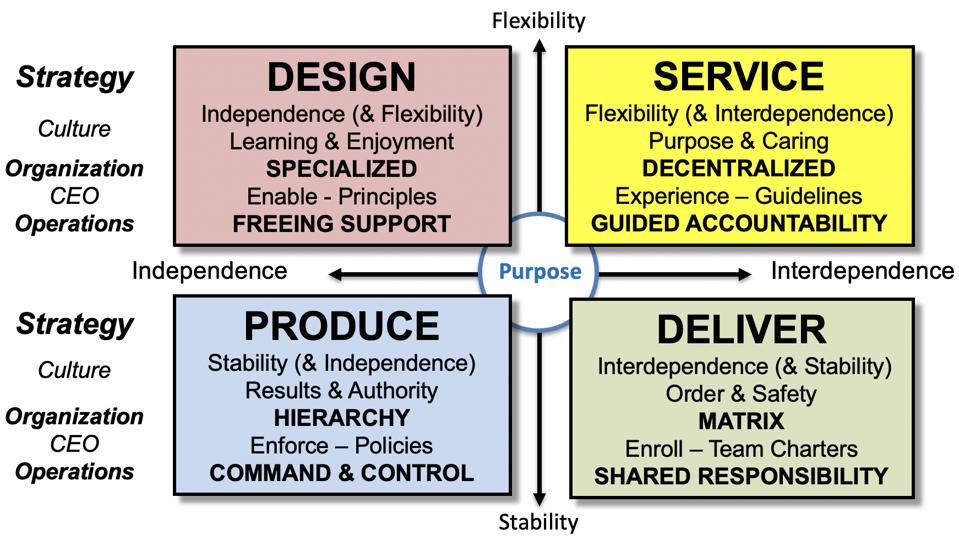
POI Framework
BRADT
This article is the third of four will take you through how to win with a delivery-focused strategy. The other three focus on design, production and service.
To focus on delivery is to build a competitive advantage in conveying valuable things from one person, place or thing to another. SIPOC helps (Supplier, Input, Process, Output, Customer):
- Your Supplier (person, place or thing) supplies you with
- The Input (what you will deliver) which you run through your
- Delivery/distribution/conveyance Process to get
- The Output (what you will deliver) to
- Your Customer.
Note the input and output are the same. You’re not involved in design – imagining valuable things. You don’t produce – making valuable things out of disparate elements. And you don’t do after sale/after delivery service. Of course, delivery is a service itself. But your focus is on conveying your input safer, faster and less expensive than others – not on the experience of the people or things you are conveying. That’s the fundamental strategic choice guiding your allocation of resources.
Value is defined as the customer’s view of the relation between your perceived, relative benefits and your perceived, relative costs.
- Design-focused organizations win by imagining new valuable things.
- Production-focused organizations win by making valuable things out of disparate elements.
- Delivery-focused organizations win by conveying valuable things from one party to another.
- Service-focused organizations win by valuably enhancing their customers’ experiences.
While most organizations do some level of design, production, delivery and service, and all must market and sell, the most successful organizations have a clear focus on one of the first four areas.
Delivery Culture
A delivery-focused organization’s main cultural driver should be interdependence. Its people should think eco-system first and ask how to make the system work better at every chance they get. Stability, order and safety matter on the way to creating scalable, repeatable processes. But interdependence and connections rule.
Matrix Organization
Matrix organizations work especially well in delivery-focused organizations. This forces the supplier and customer-focused groups within the organization to work with the functionally-focused groups. Matrices work when everyone buys into shared objectives and goals and fail when people try to protect their own turf first.
CEO as Chief Enroller
In an organization basing its success on its ability to enroll suppliers, allies and customers and clients that can benefit from each other’s offerings, the CEO has to be the chief enroller. The CEO’s job is to bring people into the ecosystem and get them to collaborate with each other.
Operate with Shared Responsibilities
Delivery-focused organizations succeed only when people accept shared responsibilities. They live in the world of hand-offs. Things have to be ready to go when people are ready to pick them up. People have to be ready to pick things up when they are ready to go. Shared responsibilities.
The main trap for delivery organizations is diversification. Many get fooled into thinking they can create more value and make more money by dialing up their services. The U-Shaped profit curve rules. Supermarkets deliver large quantities of acceptable flowers to their customers at relatively low prices. Flowerbx delivers smaller quantities of near-perfect flowers at relatively high prices. They both win. Hallmark tried to charge higher prices for barely acceptable flowers and lost.
Know what you do. Know where you play on the U-Shaped profit curve. Focus to win. Or dilute your efforts and lose.
Team charters are especially useful in matrix organizations. Use them to get team members aligned around their purpose, objectives, context, approach, guidelines and implementation accountabilities.
Click here for a list of my Forbes articles (of which this is #606) and a summary of my book on executive onboarding: The New Leader’s 100-Day Action Plan.