[et_pb_section fb_built=”1″ _builder_version=”3.22″][et_pb_row _builder_version=”3.25″ background_size=”initial” background_position=”top_left” background_repeat=”repeat”][et_pb_column type=”4_4″ _builder_version=”3.25″ custom_padding=”|||” custom_padding__hover=”|||”][et_pb_text _builder_version=”3.27.4″ background_size=”initial” background_position=”top_left” background_repeat=”repeat”]
The evening of 16 October, 2019, Boris Johnson did what the UK Parliament had legally mandated he do. He sent the EU a letter requesting a Brexit delay. This was, of course, just one step in the UK Brexit story. At the same time, it’s a classic lesson in the bare minimum compliance. Yes, he complied with the law and sent that letter. He also sent another letting telling the EU that any further delay was a bad idea. And no one knows what he said behind the scenes. But we can imagine. The lesson for all leaders is that compliance may not be enough. You need contribution or commitment.
Committed – At the highest level are the people trying to do “good for others.” They care about the organization’s purpose and teach others as part of their own self-actualization. As a leader, inspire belief with emotional communication influencing their mindset.
Contributing – One level down, contributors do things they are “good at.” They collaborate with others and help as they seek belonging and self-esteem. As a leader, help them understand with direct communication and guidelines they should generally follow.
Compliant – At the first level of engagement, compliant people “do no harm.” They show up. They observe. They focus on what’s “good for me” and meet the minimum requirements to satisfy their biological and physiological needs. As a leader, make them aware. Indirect communication is often enough. Put in place policies they must follow.
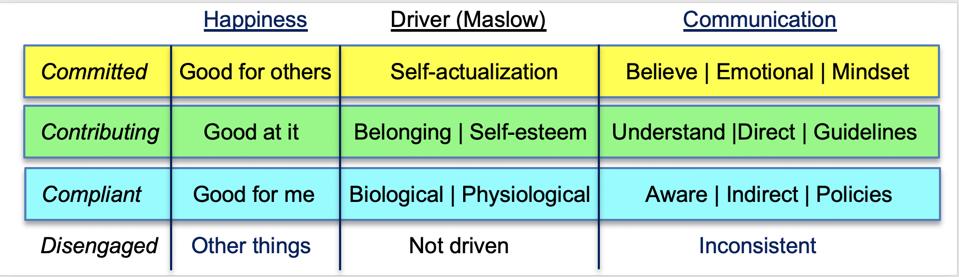
Comply – Contribute – Commit
At one level, the dispute between the UK’s Parliament and its Prime Minister, Boris Johnson, was a mis-alignment of commitment. Johnson had been clear on his commitment to Brexit at any cost. Parliament had a mess of concerns.
This directly led to Parliament directing Johnson to do something he did not think was right. It should not be a surprise to anyone that he did the minimum he had to do to comply with Parliament’s policy or law while remaining committed to what he saw as most important – Brexit at any cost.
This is why it’s so important to take into account all the different parties in any major decision including decision-makers, influencers, and implementers. Often, as we see with the UK Parliament, the same person will play multiple roles.
- Decision-makers are the people that can say yes.
- Influencers are the people that help decision-makers make their decisions. Sometimes these people have veto-power in that they can say no. Often they are behind the scenes, in the shadows. Think in terms of shadow board members, family members, mentors and the like.
- Implementers are those that turn theoretical decisions into practical actions. Things work well when they agree with decisions. When they don’t agree, they may aggressively refuse to implement decisions outright or passive-aggressively “forget” to implement decisions, or comply by doing the bare minimum they must.
In the Brexit case, Johnson was one of the decision-makers, but not the only one. He was an influencer. And was the implementer – or not.
Implications for you as a leader
- Map out the parties: decision-makers, influencers, and implementers.
- Understand their drivers, their balance of goods: good for others/self-actualization, good at it/belonging/self-esteem, good for me/biological/physiological.
- Communicate appropriately to the different parties:
- The most important are the ones that need to commit to your cause. It’s not about you. It’s about the good you all are going to do for others. This is going to require emotional, one-on-one connections to help them believe.
- You can get a long way with those that will contribute to the effort. Help these people understand how much you all need their strengths. They want to belong. They need to feel good about themselves. Employ direct communication, perhaps in small groups with guidelines to give them some degrees of freedom.
- Shore up those that need to comply. Make sure they are not disengaged. Make sure they are aware of how the effort is good for them, perhaps at basic human biological or physiological levels. Indirect communication may be enough, back up by clear, mandatory policies. Compliance is the best you’ll get. But it may be enough.
Click here for a list of my Forbes articles and a summary of my book on executive onboarding: The New Leader’s 100-Day Action Plan.
[/et_pb_text][/et_pb_column][/et_pb_row][/et_pb_section]