






[et_pb_section fb_built=”1″ _builder_version=”3.22″][et_pb_row _builder_version=”3.25″ background_size=”initial” background_position=”top_left” background_repeat=”repeat”][et_pb_column type=”4_4″ _builder_version=”3.25″ custom_padding=”|||” custom_padding__hover=”|||”][et_pb_text _builder_version=”3.27.4″ link_option_url=”https://www.forbes.com/sites/georgebradt/2019/06/04/get-an-early-read-on-how-your-new-boss-manages/#72c0033a4056″ link_option_url_new_window=”on”]
The eight essential steps of executive onboarding apply whether you’re joining a new company, getting promoted from within, or moving into an interim role. But the specifics are different for different interim roles depending upon the organizational need (steady state vs. point of inflection) and your remit (holding the fort, developmental, or probationary.) And know that in an interim role, you may not make it through all of the eight steps. Get started in the right way anyway to set your successor up for success.
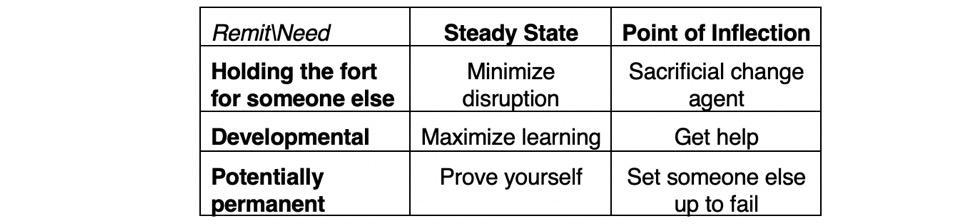
Remit vs. Need
First, The Basics
1) Get a head start: Understand the situation including the organizational need and why there’s a need for an interim leader. What happened to your predecessor? Craft your 100-Day Action Plan. Get set up. Jumpstart relationships and learning.
2) Manage the message: Position yourself before others do it for you. Start with your current best thinking around your own leadership positioning and message before Day One and adjust steadfastly as you go along. Note building trust is essential in all cases and especially challenging if people know you’re only there on an interim basis. On the other hand, no one really cares about you anyway. They care about the cause. They care about themselves. That’s true no matter how long you’re going to be there.
3) Set direction. Build the team: The first 100 days is the best time to put in place the basic building blocks of a cohesive, high-performing team. i) Imperative/strategic process; ii) Milestone management/operational process, iii) Early wins; iv) Role sort/organizational process; v) Ongoing communication.
4) Sustain momentum. Deliver results. Evolve your leadership, practices and culture to keep fueling the fires you sparked and deliver ongoing results.
The six approaches based on remits/needs
Hold the Fort/Steady State
This is relatively straightforward as you’re minimizing change. Assuming you’re overqualified for the job – as any interim leader holding the fort for someone else should be – you have nothing to prove and should have a fair amount of self-confidence. Calm everyone down. Tell them to stay focused on their mission, follow the strategies in place, and keep doing what they’re doing. Jump straight to step 4, sustaining momentum and delivering results as their first, best assistant.
Hold the Fort/Point of Inflection
Know that you’re being set up to fail. Most change agents don’t survive their own change. The change process is often so painful and so many “good” people have to go away that the change agent becomes an ongoing reminder of bad times. Stepping into the brighter future requires a new leader – which is why you’re there as the interim change leader. You can’t ever make this about you. Make it about the strategic, operational and organizational changes they have to make.
Developmental/Steady State
This is where you learn and grow. Study everything. Practice new skills. Take advantage of all the support you’re offered.
Developmental/Point of Inflection
This one’s unfair. You’re over your head with too big a task. Not only are you going to fail on your own, but you’re going to damage others along the way. Get help from someone who’s done this before and follow their guidance.
Potentially Permanent/Steady State
The secret to success here is to engage fully with the work itself while eschewing the perks of the job. Maximize impact. Minimize damage. Win over your team. Do whatever it takes to over-deliver in the job. Be a contribution. Ask “How can I help?” When they choose the permanent leader, you’ll be the only viable choice.
Potentially Permanent/Point of Inflection
In this case, you need another sacrificial lamb. Could be an outside consultant or another interim leader. Let them be the voice of change. Let them manage the process. And then publicly hang them at the end of the process much as someone else will do to you if you’re holding the fort through a point of inflection.
Click here for a list of my Forbes articles and a summary of my book on executive onboarding: The New Leader’s 100-Day Action Plan.
[/et_pb_text][/et_pb_column][/et_pb_row][/et_pb_section]