





[et_pb_section fb_built=”1″ _builder_version=”3.22″][et_pb_row _builder_version=”3.25″ background_size=”initial” background_position=”top_left” background_repeat=”repeat”][et_pb_column type=”4_4″ _builder_version=”3.25″ custom_padding=”|||” custom_padding__hover=”|||”][et_pb_text _builder_version=”3.27.4″ link_option_url=”https://www.forbes.com/sites/georgebradt/2019/06/04/get-an-early-read-on-how-your-new-boss-manages/#72c0033a4056″ link_option_url_new_window=”on”]
Positioning is a wedge – a tool designed to separate things. Those driving sharp distinction lead with their point of difference. Consultative sellers seek first to understand prospect’s needs and then narrow their message to focus on the most important of those needs. The most effective of all combine a sharply distinctive positioning with a consultative selling approach.
Those combiners run around the world trying to fit puzzle pieces together. They are confident enough in their sharply distinctive point of difference to begin conversations seeking to understand other’s needs to see if their pieces fit. If their offering is the best fit, the best tool for the task, they move forward. Otherwise they suggest other people’s tools.
Do you know the difference between a generalist and a specialist? A generalist knows less and less about more and more until eventually they know nothing about everything. A specialist knows more and more about less and less until eventually they know everything about nothing.
Both extremes are useless. Thus, I’m not suggesting extreme targeting. I am suggesting owning a positioning that gives you a sharply distinctive competitive advantage to a meaningful target and then adapting its implementation to meet that target’s needs. People don’t really believe your targeting until you say no to something that’s not on target.
Michael Porter told us that strategy is about choosing what not to do. My old boss, Harry Kangis, took that one step further by saying “Choosing not to do something that’s a bad idea is easy. The hard choice is choosing not to do something that’s a good idea – for someone else.”
Saying no to something that’s not on target is not saying it’s a bad idea. It’s just saying you don’t have the best tool to solve that particular problem. Of course, you can pound a small nail with a wrench. But it’s not the best tool. You could use a sledge hammer. Right family of tools, but still not the right one. (For delicate, precise hammering, the best choice, by far, is the stiletto heel of a Manolo Blahnik woman’s shoe. You knew that.)
Let’s recap:
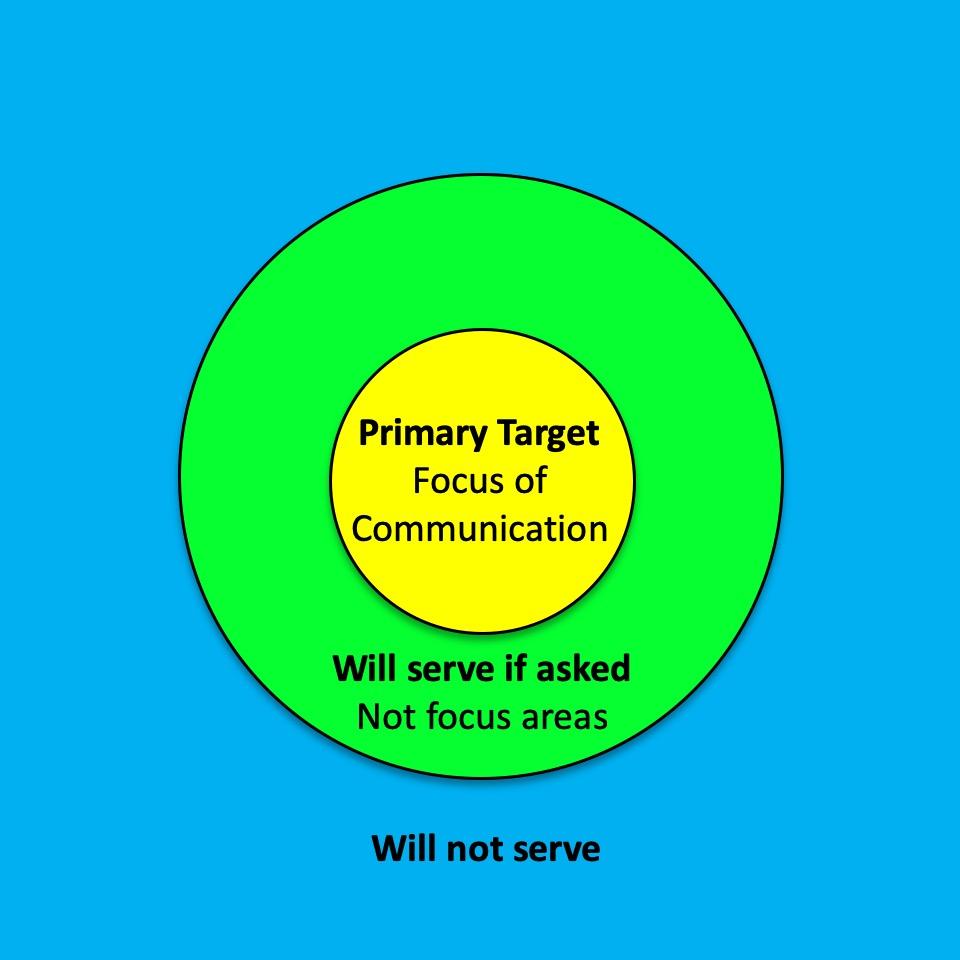
Primary target – The thin edge of the wedge of your communication. Convincing a tightly defined primary target audience that your offering is the best possible choice to solve their problem.
Will do if asked – Not a focus area. But if someone asks, you can meet their needs.
Will not serve – Just say no. Any time you spend doing this, or trying to learn how to do this, is a distraction from getting even better at your core offering, dilutes your positioning and dulls the edge of your wedge.
Targeting
Consultative sellers without distinctive points of difference seek first to understand prospect’s needs. Then they try to meet those needs as best they can with whatever tools are in their own toolbox. They are more generalists.
The sharper your point of distinction, the more often you are going to say no off-target things. Just be wary of falling into the specialists’ trap and saying no to too many things.
Application across products, services and people
Less effective product or service positioning focuses more on features and activities than on benefits. It’s less effective because no one cares what a product or service provider does. They care what a product or service does for them. That has to be the focus of your sharp point of distinction. What the product or service provider do is action. What they do for others is impact. How that makes others feel is effect.
The same is true for positioning yourself. No one cares about you. They care about what you can do for them. Lead with that. This becomes readily apparent in the first sentence and first paragraph of almost anyone’s LinkedIn profile. The less sharply positioned lay out everything they’ve done hoping that something will appeal to someone else. The more effectively positioned lead with what they can do for others.
Click here for a list of my Forbes articles and a summary of my book on executive onboarding: The New Leader’s 100-Day Action Plan.
[/et_pb_text][/et_pb_column][/et_pb_row][/et_pb_section]