
Organizations’ futures depend less on what their people know today than on how fast they can learn, adapt, and execute tomorrow. Building on Carol Dweck’s Growth Mindset – the idea that abilities can be developed through effort, smart strategies, and help from others – strengths should no longer be treated as limited by “innate” talent. They can be amplified by upgrading underlying talent, the cognitive capacity and preferred habits people draw on, and then deliberately building knowledge, skills, experience, and craft on top.
From Innate Talent to Underlying Talent
Gallup original strengths model considered innate talent, learned knowledge and practiced skills.
Dweck’s Growth Mindset challenges that “innate,” fixed‑talent assumption by showing that people who believe their abilities can be developed are more likely to embrace challenges, persist through setbacks, and achieve higher performance over time. It moves us from “this is who I am” to “this is who I can become,” especially in how we think about intelligence, capability, and potential.
More recently, cognitive scientist Phillip Campbell extends Dweck’s logic from motivation and belief to the underlying machinery of the brain. Where Dweck focuses on the mindset that makes learning possible, Campbell focuses on upgrading the cognitive capacity that makes learning and adaptation easier, faster, and more sustainable. Put together, they enable a shift from “innate talent” to “underlying talent.”
The Five Components of Strengths – Built on Upgradable Underlying Talent
With that evolution, the first component in the strengths framework becomes underlying talent. Add to that experience and craft to yield this:
- Underlying talent is the integrated cognitive capacity and preferred habits that shape how fast and how well someone can learn, adapt, solve novel problems, and sustain performance under pressure. Growth Mindset supplies the belief and behavior; Campbell’s work shows how, with deliberate repetition, that belief can translate into changes in fluid thinking, attention, and brain efficiency.
- Learned knowledge comes from books, classes, training, and lived observation – the domains and contexts executives must understand. Growth‑mindset individuals treat gaps in knowledge as opportunities, not verdicts.
- Practiced skills are behaviors and techniques ingrained through intentional repetition and feedback – how people sell, lead, negotiate, design, and communicate. Growth Mindset encourages deliberate practice; underlying talent determines how quickly and deeply those skills embed.
- Hard‑won experience is integrated insight from successes, failures, and surprises in real assignments, projects, and roles. Growth‑mindset leaders mine experience for learning; stronger underlying talent helps them see patterns and transfer lessons across contexts.
- Apprenticed craft‑level caring and sensibilities sit at the top, absorbed over time from masters whose artistic care defines excellence in design‑ and service‑driven work. Those with both Growth Mindset and upgraded underlying talent are more likely to stay in the game long enough to reach true craft‑level mastery.
Leaders can’t control where people start, but they can dramatically influence where people end up by encouraging a Growth Mindset, upgrading underlying talent, and deliberately building the other four layers on top.
The Cognitive Engine Of Growth Mindset
Dweck gives leaders the cultural and behavioral lens: hire and develop people who believe they can grow, and build systems that reward learning, effort, and intelligent risk‑taking. Campbell adds the cognitive engine that makes that belief pay off.
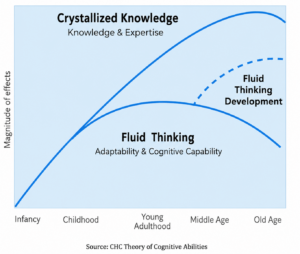
He distinguishes crystallized knowledge – the “hard drive” of expertise people have accumulated – from fluid thinking – the “operating system” that determines how well they process new, unfamiliar situations. Growth Mindset without improved underlying capacity can lead to motivated but overwhelmed leaders. When leaders systematically enhance fluid thinking, attention control and brain balance, they give growth‑minded executives more bandwidth to take on stretch assignments, absorb complexity, and lead through uncertainty.
Campbell says, based on 70 years of research into the CHC Theory of Cognitive Abilities, crystallized knowledge keeps on being accumulated throughout life. However, fluid thinking peaks at young adulthood (20 – 30 years old) and declines as the brain ages, unless it’s deliberately upgraded.
Future Capability Planning
With Growth Mindset and underlying talent in view, Future Capability Planning becomes even more powerful.
- Determine the organizational capabilities and strengths you’ll need to implement your strategy.
- Assess the strengths and mindsets of your current people.
- Determine which current people can be developed by upgrading the underlying fluid thinking capacity and building full strengths.
- Recruit others now who have some missing strengths components, but have high fluid thinking capacity and a clear Growth Mindset.
- Recruit others just‑in‑time with all of the missing strengths – and have fluid thinking capability and the mindset to keep growing.
Leaders who connect Dweck’s Growth Mindset to this evolved strengths model – and then use Campbell’s work to upgrade underlying talent – won’t just fill today’s roles more effectively. They’ll build organizations whose people are wired to keep learning, whose brains are tuned to handle whatever comes next, and whose strengths deepening is built into the way the business runs.