
Leaders don’t simply get the followers they deserve; they get the decisions they design for. When leaders understand the different ways people create value – artistically, scientifically, and interpersonally – and consciously elevate those perspectives, they make better, safer, and more courageous calls. When they don’t, they set the stage for catastrophe.
The three types of leaders
One way to segment leaders is artistically, scientifically, and interpersonally.
Artistic leaders are creators and visionaries. They imagine possibilities and shape compelling narratives. They see what could be and rally people around a future that doesn’t exist yet.
Scientific leaders are analysts and experts. They test assumptions, run experiments, build models, and speak for the data. They see patterns, probabilities, and risks others miss.
Interpersonal leaders are connectors and integrators. They create the conditions in which artists and scientists can do their best work together. They set culture, expectations, and the decision‑making environment. They don’t need to have the best ideas or the deepest technical expertise; they need to bring out the best ideas and the deepest expertise in others. 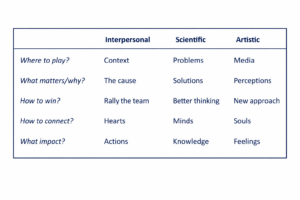
The most effective interpersonal leaders, especially when the stakes are high, lean into the differences. They bring out the best in their artistic and scientific colleagues by bowing to their sensibilities and judgment when the moment demands it. They know when the story needs to yield to the science – and when the science needs to be framed by a bigger story.
Two historical episodes illustrate the difference between interpersonal leaders who truly empower experts and those who don’t: the Challenger disaster and Eisenhower’s decision around the D‑Day date.
When interpersonal leadership fails: Challenger
The space shuttle Challenger exploded 73 seconds after liftoff in January 1986, killing all seven crew members – a failure of leadership and culture as much as technology.
Morton Thiokol engineers, responsible for the solid rocket boosters, were deeply worried about Oring performance in the cold. They had seen erosion and blowby before and knew the forecast launch temperature was far below any proven safe range.
These engineers were the scientific leaders. They understood the data and failure modes and did what scientific leaders should do: raise alarms and recommend a “nogo.”
Interpersonal leadership failed.
NASA faced schedule pressure, public expectations, and a powerful artistic narrative: the first teacher in space, live on national television. Managers at NASA and Thiokol became guardians of that story, asking “how do we launch” instead of “should we launch.”
No one with interpersonal authority said, “The narrative must bend to the science.” Thiokol’s senior leaders let pressure and the desire for consensus sway them, pushed the engineers to reconsider, and reversed the initial “nogo.”
The result was groupthink: dissent muted, risk normalized, danger rationalized. Scientific leaders were present and largely right; artistic leaders had a compelling story. Interpersonal leaders never stood in the intersection and insisted that the story submit to the data.
A failure of interpersonal leadership turned technical risk into human tragedy.
When interpersonal leadership succeeds: D‑Day
Contrast that with Allied Supreme Commander Dwight Eisenhower in June 1944.
The D‑Day invasion of Normandy was the largest amphibious assault in history, with hundreds of thousands of lives and the entire European strategy of World War II at stake in a surprise assault that would open a Western front and begin the liberation of Europe. Planning, logistics, and morale were geared toward moving now. Delay meant risk of discovery, loss of momentum, and immense operational complications.
Success depended on timing: tides, moonlight, surprising the enemy – and above all, weather in the English Channel.
James Stagg, a Scottish meteorologist leading a combined forecast team, held the scientific leadership role. He and his colleagues combed through data from ships, aircraft, and remote stations, tracking pressure systems and fronts. Stagg concluded that 5 June, the initial target date, would be marked by a severe storm, making the crossing dangerous.
In the critical meetings, Eisenhower did not treat Stagg as a technician to be managed. He treated him as a partner whose judgment might override the entire plan. He asked probing questions, listened to conflicting forecasts, and watched Stagg wrestle with uncertainty. And when Stagg advised postponement, Eisenhower accepted the delay – even with ships already at sea and troops poised to go.
Then, 24 hours later, Stagg saw a narrow window of improving weather that could make the operation possible on June 6. Eisenhower then chose to launch one day later than the original plan, and the invasion went ahead in rough, but passable, conditions. The Germans, expecting continued bad weather, were caught off guard.
The followers – and decision – you deserve
In both stories, the artistic and scientific leaders were present. In both, the facts and the narratives were visible. The difference was the actions of the interpersonal leaders.
When interpersonal leaders prioritize consensus, optics, and momentum over honest conflict, they get followers who withhold their best judgment and decisions that drift toward disaster. When they prioritize truth‑seeking, dissent, and respect for expertise, they get followers who bring forward their hardest insights – and decisions, like Eisenhower’s D‑Day call, that change history for the better.
Ultimately, you will get the followers – and the decisions – you deserve. The question is whether you choose to deserve Challenger or D‑Day.