Operational leadership is the undervalued fulcrum between theory and reality. It is where strategy stops living in slide decks, where culture becomes observable behavior, and where tactics gain the coherence and speed that separate winning organizations from the rest.
From Elegant Theory to Messy Reality
Cultural and strategic leadership are intellectually appealing. They trade in vision, values, positioning, and narratives senior leaders love to discuss. Cultural leadership defines the purpose of the enterprise and the norms of “how we do things around here.” Strategic leadership converts that into choices about where to play and how to win, then sets Direction and allocates Resources.
Tactical leadership, at the other end, is where things actually happen. It is the sales call, the plant turnaround, the service recovery, the product release. But tactics, left on their own, fragment. Local teams optimize locally, firefight reactively, and often pull against one another. Strategy without tactical follow-through is theater; tactics without strategic context are noise.
Operational leadership is what prevents both pathologies. It is the connective tissue that translates strategy into coordinated tactics while feeding ground truth back up to refine strategy.
The Nested Leadership Model
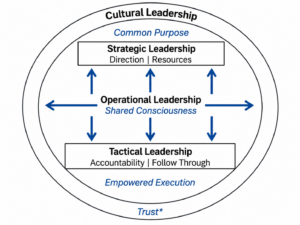
Think of leadership as four nested layers: cultural, strategic, operational, and tactical. Around the outside sits cultural leadership, establishing Common Purpose: why we exist and what we will and will not do. Inside that, strategic leadership sets Direction and marshals Resources to pursue that purpose.
Operational leadership lives in the middle of the system. It is the only layer that touches both the C‑suite and the frontline every day. It is where shared consciousness is built and maintained, as operational leaders constantly communicate across functions, geographies, and time horizons. At the core, tactical leadership focuses on Accountability and Follow Through: “Who will do what, by when, with what success measures?”
Delegation as the Backbone of Tactical Capacity
The DRAFT delegation framework—Direction, Resources, Accountability, Follow Through—is, in effect, a practical operational-leadership operating system.
- Direction: Operational leaders ensure strategy is decomposed into clear, unambiguous objectives for each team.
- Resources: They allocate people, capital, time, and information so those objectives are achievable.
- Accountability: Overall ownership of results. Drive decisions. Ensure implementation.
- Follow Through: They install cadences of check‑ins, reviews, and after‑action learning that keep execution on track and adaptive.
Done well, this does more than drive compliance. Once teams understand the “why” and “what,” and have the resources to act, they can move faster at the edge—where customers are, where operations live, and where competitors show up. That is Tactical Capacity: the ability of an organization’s frontline to make sound, timely decisions aligned with intent without waiting for approval from the top.
In high-performing organizations, you can feel this capacity. Meetings are shorter and more focused because decisions are made closer to the work. Escalations are about exceptions and learning, not routine approvals. Tactical leaders know how their work connects to the strategy and to each other.
Shared Consciousness and the Role of Trust
McChrystal’s Team of Teams construct highlights four intertwined elements: Trust, Common Purpose, Shared Consciousness, and Empowered Execution. Operational leadership sits right at the center of that framework.
Shared consciousness is not about flooding the organization with information. It is about ensuring that the right people have the right context at the right time so they can act in concert without waiting for orders. Operational leaders enable this through:
- Cross-functional forums that prioritize sensemaking over reporting.
- Transparent metrics that everyone can see and interpret the same way.
- Frequent, candid communication that updates assumptions as reality shifts.
Underneath that sits trust. McChrystal’s own definition emphasizes faith in the intent/benevolence, competence/capability, and reliability/integrity of teammates. Add to that Amy Edmondson’s psychological safety defined as a belief that the workplace is safe for speaking up with ideas, questions, concerns, or mistakes, as a prerequisite for real learning and high performance and you get these four elements:
- Intent or benevolence: I believe you want what is best for the team and enterprise.
- Competence or capability: I believe you are able to do what the role requires.
- Reliability and integrity: I believe you will do what you say you will do, when you say you will do it, consistently.
- Psychological safety: I believe I can tell you the truth—and you can tell me the truth—without fear of punishment or humiliation.
Operational leaders are uniquely positioned to model this: asking for input, admitting their own fallibility, and rewarding candor even when the news is bad. When they combine clear Direction and Resources with high Accountability, robust Follow Through, and this richer notion of Trust, they convert shared consciousness from a leadership aspiration into an everyday, team‑level reality.
What This Means for Senior Leaders
Senior leaders who treat operational leadership as “middle management” to be streamlined or bypassed are undermining their own strategies. Culture and strategy still matter deeply; they set the boundaries and the story. But without strong operational leadership, they remain elegant theories.
If you want your strategy to live in the world and not just on slides, invest disproportionately in your operational leaders. Select, develop, and reward them not only for functional expertise, but for their ability to:
- Translate strategy into cohesive, cross-functional execution.
- Build shared consciousness across silos.
- Use the delegation framework to grow Tactical Capacity.
- Create trust that includes psychological safety, not just likability.
Do that, and you will discover that the underappreciated power of operational leadership may be your single biggest untapped competitive advantage.