We’ve come full circle. For most of our existence people sold things to others through one-on-one relationships. It’s only since World War II that mass media has enabled the few to sell to the many with any effect utilizing one-way communication. Now we’re going back to two-way conversations, enabled by new technologies – social media. Go beyond communicating your brand messages to customers, beyond two-way conversations between you and those customers, all the way to building a community by enabling customers to have conversations with each other.
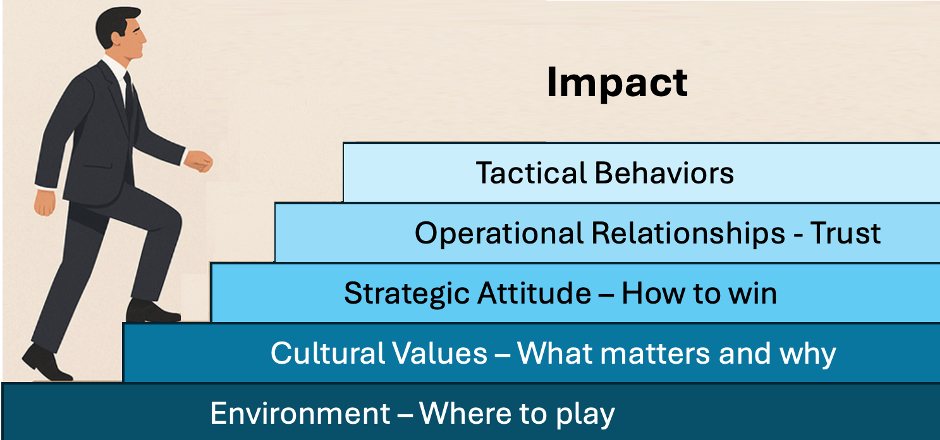
LiveWorld’s Peter Friedman explained this to me at the start of a conversation we had that led to co-creating a BRAVE approach to social media. The BRAVE framework is from my new book, First-Time Leader. The social media implications are from Friedman. Putting them together yields a BRAVE new approach to social media encompassing behaviors, relationships, attitudes, values and the environment from the outside in.
ENVIRONMENT: Where to play – context
It’s a noisy world out there. Technological advances have enabled anyone to publish stuff. And, like Ellen DeGeneres at the Oscars, they are. Yet, as Friedman explains, “the majority of social media is not social It’s still traditional advertising, print, digital and PR approaches shoved through social channels. It needs to and will move towards being truly social with a focus on dialogue among and with customers, which in turn builds relationships.…Still social media has moved from being an experiment, to another channel, to a big channel, to the main channel, to the main driver of attention.” Know that you must play. Know that standing out is going to get harder and harder.
VALUES: What matters and why – bedrock
If you’re not clear on what you’re trying to do and why, don’t even start. Clarify your goals. Make sure there’s an ROI whether it’s new customers, new sales, enhanced reputation or something else. Be crystal clear on the organizational or brand principles that you will not sacrifice on the way to success. LiveWorld uses a party metaphor since parties are social by definition and can vary in story, tone and context. Think about what kind of party is your brand’s social media presence.
APPROACH: How to win – choices
Make clear choices about your strategy and approach. Friedman took me through the Zoetis EQ Stable case study. This Pfizer spin-off sells drugs for animals. Guess what. The end users don’t get a vote. It’s all about veterinarians and animal owners. Thus Zoetis built a social media platform called the EQ Stable, including a new Facebook page to give horse owners a place to relate to each other. People gathered, a community developed, and Zoetis captured their names.
RELATIONSHIPS – How to connect – engagement
The most important social media relationships are the ones between members of your community. Friedman explained that most marketers still view social media platforms as another way to broadcast their brand messages to customers and get some viral spreading of that broadcast message. More enlightened marketers are leveraging social media platforms to build relationships with their customers. The most successful social marketers are building communities.
Like Walmart. There are over 34 million followers of the Walmart Facebook page. Their secret is in focusing relentlessly on the customer experience. With Friedman and LiveWorld’s help they took a page out of Apple’s old playbook. Apple knows it’s not about the technology. It’s about the person’s experience supported by the technology. Leveraging their strong cultural footprint that so much of America identifies with, Walmart is not only the largest brand on Facebook within the U.S., but one of the most engaged.
BEHAVIORS – What impact – action
“You have to be brave to do this. You have to let go of things,” says Friedman. Moving from broadcast, to engagement, to deep involvement through conversations to ongoing relationships requires letting go of your “brand first” mentality. Indeed, Friedman’s prescription is for 40% of your social messaging to be social; about and by the people in your community, 40% to be about the category or context and only 20% to be about your brand and products. If you build the community, the community will build your brand.
Along the way there will be crises. They are going to happen. The only question is whether you are going to be prepared. Be alert for them. Have a plan in place with your stakeholders and possible approaches already identified. Ground everything in a strong cultural model. Not only will a strong community build the brand, its members will defend “their” brand when it is wrongfully attacked. Friedman points out that “There’s always an opportunity in a crisis.” You want attention. You get it in a crisis. It’s up to you to turn its impact positive.
Follow this link for an overview of George Bradt’s New Leader’s Playbook and click-throughs to all the articles on executive onboarding and BRAVE leadership.