
This note highlights the main ideas and insights from last week’s CEO Exchange around cultural, strategic, operational, tactical, and personal leadership at the CEO level. Most importantly, these CEOs now understand that with AI, we are all “facing a transformation unlike anything we have ever seen. It is a train coming hard and fast, and most organizations are simply not ready for what is about to hit them.”
We’ve run over 50 of these exchanges over the last 20 years, first as CEO Connection’s CEO Boot Camps and now as PrimeGenesis CEO Exchanges. They are intensive one day, peer-driven forums in which 6–12 CEOs, rising CEOs, and board members exchange experiences, perspectives, and insights to deliver better results faster back at work.
Last week’s attendees were acutely aware of the impact of AI, noting that the world changed in February with the launch of agentic AI—specifically tools like Claude Code and Cowork—and their ability to autonomously perform complex software engineering and administrative tasks.
There are already some organizations in which human work is being assigned and supervised by AI agents. (Re-read that last sentence. It’s a completely new thing.) One CEO described a future where a focused team of five achieves the same output that previously required 500, driven by agentic workflows minimizing “human-in-the-loop” checks through a functional redesign of how work gets done.
Others noted the immediate reality is likely a significant efficiency shift: headcount remaining relatively flat while productive output is expected to double. As one CEO framed it, we’re in the first inning of a nine-inning game that will play out over the next 24 months, though the ‘long poles in the tent’ remain corporate culture, legal frameworks, and security protocols.
This environmental change will affect cultural, strategic, operational, and tactical leadership in line with the nested leadership framework.
Nested Leadership – All within the ever-changing Environment
- Cultural leadership is rooted in Values: Who we are, what matters, and why.
- Strategic leadership is about Attitude: Where to play and how to win choices.
- Operational leadership is about Relationships: How to connect, communicate, and build trust across business units and functions.
- Tactical leadership is about Behaviors nested in operational guidelines, strategic choices, and cultural mandates, all adding up to the most important impact and results.
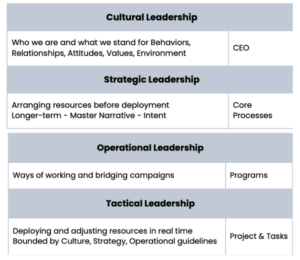
Cultural Leadership – Who we are and what we stand for
Core Focus Framework
While all organizations design, produce, sell, deliver/distribute, and service, the most effective ones pick one core focus and let that inform everything else.
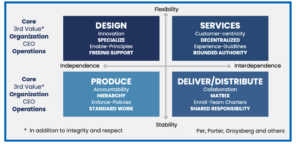
Culture is made up of Behaviors, Relationships, Attitudes, Values, and Environment. AI has changed your context. Be intentional about how you preserve your values as you change your attitudes, relationships, and behaviors in response to all the changes that must flow from that contextual change.
Strategic and Organizational Leadership – Arranging resources before deployment
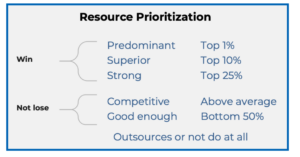
Strategic leaders decide where to play, where not to play, and how to create and allocate scarce resources to enable operational and tactical leaders.
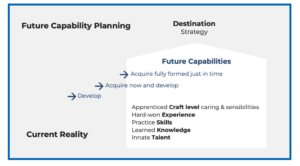
Strengths are made up of innate talent, learned knowledge, practiced skills, hard-won experience, and, as appropriate, apprenticed craft-level caring & sensibilities. Then, future capability planning is all about building the capabilities with the strengths required to execute your strategy. Note that, as Seth Godin put it, each of us is either going to figure out how to get AI to work for us or will be working for AI. Your future team is going to be made up of humans and AI agents.
Operational and Tactical Leadership – Ways of working and bridging campaigns
Operational leadership lives in the middle and is about relationships – cross-functional coordination, communication, orchestration, and execution. Business-unit and functional leaders translate attitudes into operating models, align their peers, and make sure handoffs across the matrix work to build trust in each other’s benevolent intent, competence and capability, and consistent reliability.
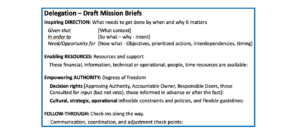
Be explicit about how your operational and tactical leaders should leverage AI as an enabling resource.
Ways of Working
The choice of your core focus leads to different ways of working within different cultures and organizational designs. Pulling from Amy Edmondson’s book, “Right Kind of Wrong: The Science of Failing Well,” and the definition of three types of failures (defined as outcomes that deviate from desired results):
- Intelligent failures: Good failures necessary for progress. Involve careful thinking. Take place in novel territory. Opportunity driven. Informed by prior knowledge. As small as possible to generate useful learning that advances our knowledge.
- Basic failures: Stupid ones caused by mistakes and slips. Can be avoided with care and access to relevant knowledge. Known/consistent territory; but didn’t use our knowledge because of mistakes of inattention, neglect, overconfidence, or faulty assumptions.
- Complex failures: Have not one, but multiple causes, and often include a pinch of bad luck in a variable situation. Potentially catastrophic. Often preceded by subtle warnings.
Personal Influence and Impact – With the organization and board
One of the huge differences between CEOs and everyone else is the demands on a CEO’s time and energy, including managing the board.
CEO Time & Energy Management
Current => Aspiration
15% up and out => 33%
15% with customers => 33%
70% down => 33%
Board Management
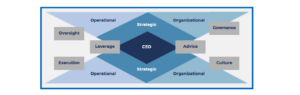
The board owns oversight and governance and can provide advice and leverage.
The CEO manages the board and owns the organization’s culture and execution.
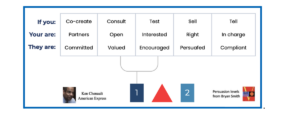
Board two-step: 1) Consult or test. Then 2) Sell. Boards don’t co-create and don’t like to be told.
When asked what they were going to do differently tomorrow, these CEOs now understand the need to dial up their AI use in all sorts of different ways, and:
- “Be more explicit about the Behaviors. Relationships, Attitudes, Values, and Environment that define our culture.”
- “Re-look at KPIs through the organization to make sure we’re clear on what people should be getting done.”
- “Document information flows.”
- Take the time to memorialize how we enable tactical decision-makers.”
- “Communicate even more transparently.”
- “Calendar audit to make sure I’m spending time appropriately up and out, with customers, and down.”
- “Utilize these frameworks to up our basic blocking and tackling as we focus on solutions.”