
If things are going generally well and people are heading in the right direction, deploy judo leadership, tactically redirecting their momentum. But if people are complacent or in a crisis, counter their mood, changing their state of mind and emotions and urging them on or calming them down so they can focus on what matters most.
Judo Leadership
Judo leadership is about half-full glasses. There are those that focus on the half-empty part and those that focus on the half-full part. You know whom you’re dealing with their initial response to one of your ideas.
The half-empty people respond with comments that trigger fight or flight reflexes. They are perceived as challenges at best and attacks at worst:
- “Needs more supporting data.”
- “Your conclusions aren’t clear.”
- “Not sure that will work.”
The half-full people make others feel supported. They lead with comments that open others up to whatever comes next – which should be even more support to redirect their positive momentum:
- “What great research!”
- “Terrific insights!”
- “We can make this work!”
In a lot of ways, judo leadership is just this simple:
- Think half-full. Or 25% full. Or 1% full. But focus on what’s good, working, done right first.
- Credit what’s good, working, done right with a positive comment like the ones above.
- Build on that with an addition. “And we could…” (Judo leadership is about “and” not “but.” “But” negates everything that comes before it.) These should add value to what’s already there with a modification, an additional benefit, another application, a new way to realize their original intent.
- Check back to make sure you’ve preserved their idea. “Does this fit?”
Mood-Countering Leadership
Sometimes you need more than tactical re-direction. Sometimes you need a complete mood and mindset shift.
Counter complacency. One brand team had hit its annual targets nine months into the year. They relaxed. Their boss pulled them together, congratulated them on their accomplishments and pushed them for a plan to further accelerate their business over the remaining three months.
Counter stress. The primary role of leadership in times of crisis/disruption is to counter the mood with values-based conversations balancing “deliberate calm” and “bounded optimism” while demonstrating empathy and communicating effectively – maintaining transparency, clear expectations, and providing frequent updates.
Change only happens when A x B x C > D:

Countering Inertia
BRADTInertia and fear of the unknown are powerful forces. Mood-countering leaders must connect with people emotionally to get them to commit to a new path.
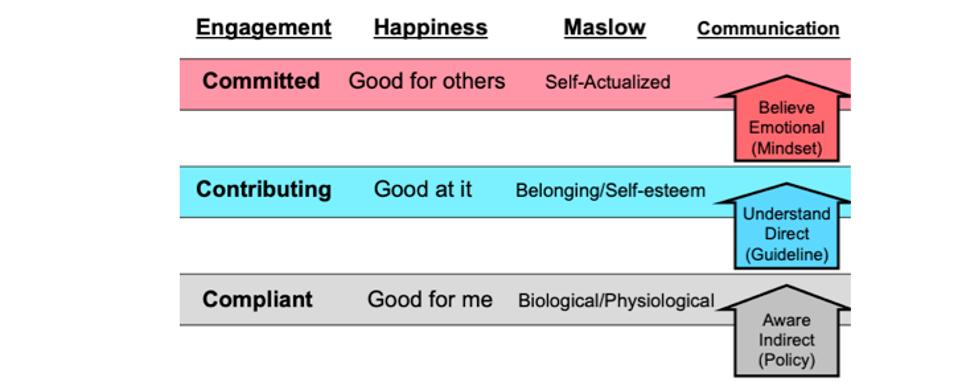
- If all you need is compliance, you can play at the bottom of Maslow’s hierarchy and focus on what’s good for them, indirectly making them aware of policies through indirect communication.
- If you need your audience to contribute, they need a sense of belonging and self-esteem. Play to what they are good at and build understanding by directly communicating guidelines through small group conversations.
- If you need their commitment, it has to be to a cause beyond themselves – something that is good for others in line with the organization’s mission, vision, and values. This gets to the top of Maslow’s pyramid and requires emotional connection to change their beliefs and mindset.
Communication
BRADTMood-countering leadership
- Connect emotionally. Start with why they should listen to you. Make it personal in a way they can relate to. Be authentic, relatable and vulnerable as you empathize with how what’s going on impacts them personally.
- Lay out the objective facts of the current reality in a deliberate, transparent, and calm way.
- Paint a boundedly optimistic picture of the future – in which your audience can picture themselves. It has to be credibly possible.
- Invite them to be part of the solution with a call to action including specific things they can do now. Be clear on the expectations.
- Follow-through. This is not going to be a one-time event, but, rather, a series of iterative conversation
Click here for a list of my Forbes articles (of which this is #627) and a summary of my book on executive onboarding: The New Leader’s 100-Day Action Plan.