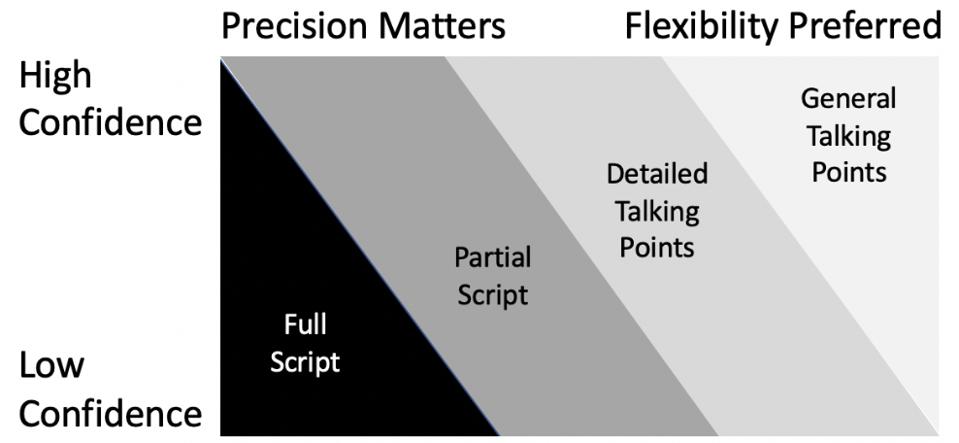
Talking points and full scripts each have advantages and disadvantages. Choose between them based on how precise your words need to be and your own confidence in the subject. Leverage talking points when you’re confident and can be flexible. Use a full script when your confidence is low and precision matters.
Script v Talking Points
BRADT
Charlie Shimanski’s first major gathering as head of the Red Cross’s Disaster Response organization and US Secretary of State Colin Powell’s presentation to the UN on Iraq’s weapons of mass destruction provide opposite examples.
As described in an earlier article on Shimanski’s first gathering, his message was more about feelings than specifics. What he cared most about was making the attendees feel proud of the work they were doing to help victims of disasters. He had a lot of confidence in his message and his ability to deliver it and he had extraordinary flexibility in how he and others delivered that message throughout the gathering. Shimanski needed only the most general talking points.
Conversely, Colin Powell was asking the UN to authorize an invasion. Millions of lives were going to be disrupted. People were going to die. Furthermore, Powell did not have any confidence in the data he was presenting. In this case, every word he said mattered. He needed to be clear on precisely what he was going to say when and followed his full script in detail.
Those are the extremes. Let’s explore the middle ground as well.
General Talking Points
Shimanski used the most general of talking points. Actually, it was only one talking point over the entire three-day conference, “Make them feel proud.” Sometimes, that’s all you need if you’re confident in your material and you want things to look natural and fluid. Do keep in mind Mark Twain’s quote, “It takes about three weeks to prepare a good impromptu speech.”
Impromptu toasts fall in this area whether or not you’ve had three weeks to prepare. You may want to make just one point and then sit down. Or, you may want to build your toast quickly off the past – present – future formula:
· I’ve known X since. They were always particularly noteworthy because of Y.
· We’re here today to celebrate X’s….It’s particularly wonderful because of Z.
· Our hopes for X going forward are….
(Works every time.)
If you’re an executive onboarding into a new job, you generally want to have one overall message and three main talking points. You need to have confidence in what you’re saying and have the flexibility to adapt those talking points to different situations.
Detailed Talking Points
The next level up if you want to be a little surer of your materials or more precision is required is detailed talking points. By definition, these will include more specifics than will your most general talking points. You may utilize some brief notes. No one’s going to think poorly of you for referring to your phone, a piece of paper, or note cards to make sure you get your facts right. This may be appropriate for more formal meetings, panel discussions or press interviews.
Partial Script
Use a partial script if you need to get some wording precisely right and can leave other parts more flexible. This might happen if you’re presenting a detailed plan that you need to get right before explaining the emotional impact of what you’re proposing. You’ve seen people read parts of a presentation from a script and then put their notes down to look their audience straight in the eye to connect.
Full Script
Using a full script is not a sign of weakness. Instead it communicates that you care enough to get your words precisely right and recognize the context requires your best preparation. Of course, if you really care, you’ll prepare in advance and memorize the full script. Witness the best speeches at the academy awards, the best TED talks and some of the eulogies that have reached in, tore your heart out and crushed it to bits.
Click here for a list of my Forbes articles and a summary of my book on executive onboarding: The New Leader’s 100-Day Action Plan.