[et_pb_section fb_built=”1″ _builder_version=”3.22″][et_pb_row _builder_version=”3.25″ background_size=”initial” background_position=”top_left” background_repeat=”repeat”][et_pb_column type=”4_4″ _builder_version=”3.25″ custom_padding=”|||” custom_padding__hover=”|||”][et_pb_text _builder_version=”3.27.4″ link_option_url=”https://www.forbes.com/sites/georgebradt/2019/06/04/get-an-early-read-on-how-your-new-boss-manages/#72c0033a4056″ link_option_url_new_window=”on”]
As I said in an earlier article on What It Takes To Accelerate Through A Strategic Inflection Point, there are four primary areas of focus: design, produce, deliver, or service. Pick one as your main strategic focus, with other activities and your culture flowing into or from that. Said it. Meant it. Still believe it. But if that is all you do, you’re heading for a cliff. Every organization has to get all four of these done as well as marketing and selling. It’s a question of balanced focus, not complete exclusion.
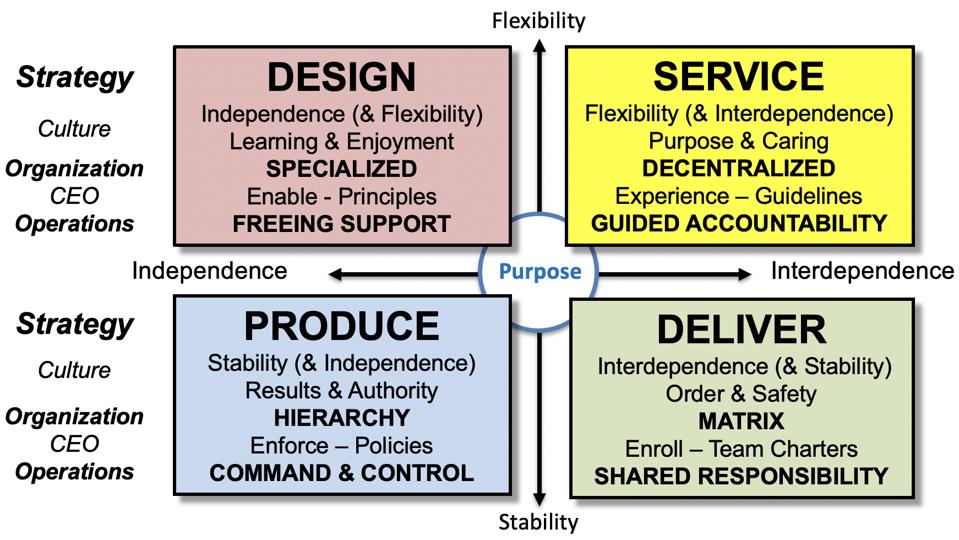
POI Framework
You know the difference between generalists and specialists. Right? Generalists know less and less about more and more until eventually they know nothing about everything. Specialists know more and more about less and less until eventually they know everything about nothing. Both go off the cliff into uselessness.
At the same time, leading requires choices – and bold, decisive choices at points of inflection. Picking one single strategy and aligning it with one culture, organization, and way of operating seems riskier than keeping options open. But choosing to be best in class at one thing versus good enough at many can be the difference between success and failure. Pick one.
That one strategy, culture, organization and way of operating will be your competitive advantage. As Orwell taught us, all animals are created equal. Some are more equal than others. The one combination is the most equal. And, within that combination, culture is the only sustainable competitive advantage.
Pick one combination and become best in class in that – superiority. Let that combination lead everything else. But don’t let it drown out everything else. Every organization and its ecosystem need to be complete, designing, producing, selling and marketing, delivering and servicing. The most successful organizations are best in class at one thing and find ways to be world class at other things (parity.)
The choice here is make, buy, or partner?
Make
If you choose to be best in class/superior at something, you have to make it yourself. The best designers do their own design. The best producers do their own producing. The best deliverers do their own delivering. The best servers do their own servicing. And all invest in innovation and training and development to stay ahead of the curve in their primary areas.
Buy
If you choose to be less than best in class, the best choice is not to make it yourself. Outsource design, production, delivery or service, buying them from someone else who is best in class, world class or strong in those areas.
Why?
Because any resources you invest in making yourself world class, strong or good enough in areas other than the area of your primary focus is a distraction from that area of primary focus. It’s wasted money, time or effort. If the goal is less than superiority, you’re conceding that others can do it at least as well as you. Let them invest in it. And then buy from them.
Of course, there are situations in which it will make sense to make and control some things outside your primary area. These are generally defensive situations to manage the risk of someone else leveraging control of something else to hurt you. If someone else owns the goldmine, your gold is useless.
Partner
This gets us to partnering. Partnering can be the no man’s land between making and buying. It’s often a good idea to partner with someone on the way to acquiring them – almost like an extended due diligence. Sometimes it makes sense to have a preferred “partnership” with a vendor as a way to lock in supply. Just know that you can’t stay in no man’s land indefinitely. Know which partners you should buy from and which you should buy.
Net, consider the full value chain: design – produce – market/sell – distribute – service. Make sure everything’s getting done. Do the thing yourself that will give you a competitive advantage. Let others do the rest and manage the hand-offs and interdependencies.
Click here for a list of my Forbes articles and a summary of my book on executive onboarding: The New Leader’s 100-Day Action Plan.
[/et_pb_text][/et_pb_column][/et_pb_row][/et_pb_section]