New IBM CEO Arvind Krishna is going to continue to drive IBM’s cloud business. That choice has already been made. The choice he faces is how best to do that. The answer is probably cloud as service – for the moment.
Ginni Rometty started moving IBM into the cloud to make it more relevant, but didn’t go far enough or fast enough. As Andrew Ross Sorkin wrote in the The New York Times’ Deal Book, January 31, 2020,
“The company still relies more on slow-growing hardware and software businesses than cloud computing, A.I. and data analysis.
Shares in IBM fell 25 percent during her tenure, while those in Microsoft jumped 500 percent.”
IBM is in trouble and in decline. It has been there before and recovered when Lou Gerstner famously led the change from hardware to service. Now Krishna has to catch up in the cloud. Leading through that point of inflection starts with picking a strategy.
Michael Porter’s value chain insights taught us that all organizations design, build, sell and market, deliver and service. The most effective organizations focus on one of design, build, deliver or service as the anchor for their competitive advantages. They invest to be best-in-class in that area while accepting world-class, strong, or good enough in other areas.
The trouble with playing catch-up is that others have already staked out their positions. When it comes to cloud computing, Amazon is winning with a distribution-focused strategy. Microsoft is doing well with a product-focused strategy.
Krishna and IBM’s choosing to try to displace either of them with their strategies is doomed to failure. This means Krishna has to choose a different approach. The most logical is cloud as service, building on IBM’s current service focus. That gives them the greatest chance of success – at least until Apple designs a whole new approach to the cloud and blows everyone else out of the sky.
As laid out in my earlier article on what it takes to accelerate through a strategic inflection point, that strategic choice dictates the organization’s approach to culture, organization, operations and what the “E” in CEO means.
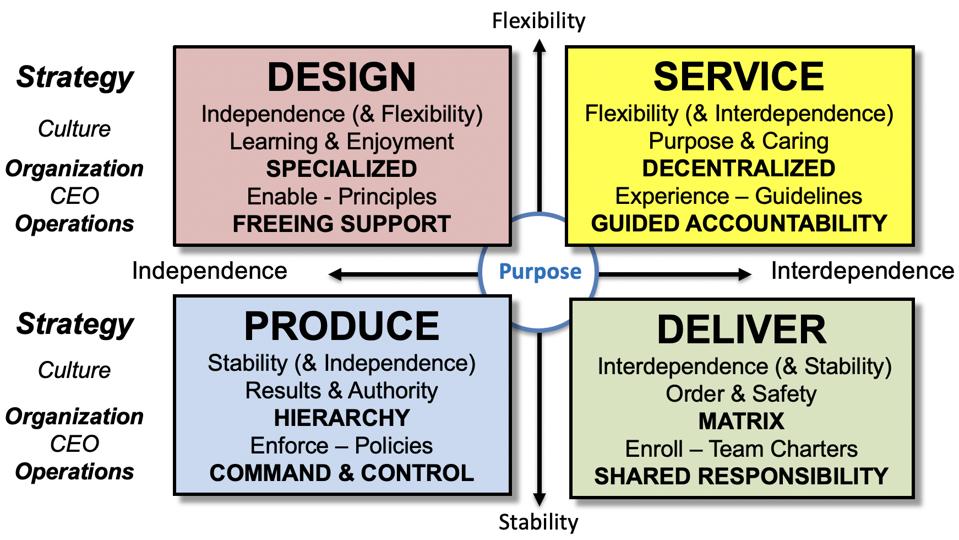
POI Framework
BRADTCulture of flexibility
IBM will need to evolve to a culture of flexibility (and interdependence.) IBMers will need to think “customer-first” and have the flexibility to do what it takes to delight customers. This requires interdependence across groups, all working as one to serve the customer. It requires fundamental mindsets driving purpose and caring about customers and each other.
Newly named President of IBM who was acquired with Red Hat, Jim Whitehurst, ran straight into this when he initially joined Red Hat. There he became a catalytic leader, but only after he was able to embrace the organization’s unshakable focus on its mission. As he wrote, “The code talks.”
Organization
IBM will have to become more decentralized, pushing decisions down and out so the people closest to the customer can make decisions in the best interest of customers (and IBM.)
Operations
The key to operating effectively in a decentralized, service organization is guided accountability. It’s counter-intuitive, but clear guidelines free up decentralized leaders to make decisions. Knowing what choices they can and cannot make makes it easier for them to focus on the choices they can make and not worry about the rest.
The second part is accountability. If they get to make choices, they need to live with the consequences of those choices – both positive and negative.
Chief Experience Officer
CEOs’ primary approach must align with the organization’s core strategy. While situational leadership requires a fair degree of flexibility,
- The CEO of a design-focused organization has to be the chief enabler, fighting to give the designers room to create.
- The CEO of a production-focused organization has to be the chief enforcer, making sure the planes fly right every time.
- The CEO of a distribution-focused organization has to be the chief enroller, bringing people into the eco-system.
If Krishna chooses to focus on cloud as service, he must be the chief experience officer, pushing everyone all the time to make their customers’ experience with IBM’s cloud superior in every way to any other cloud offering. The good news is that superior experience beats superior product and distribution – assuming the product and distribution support the experience.