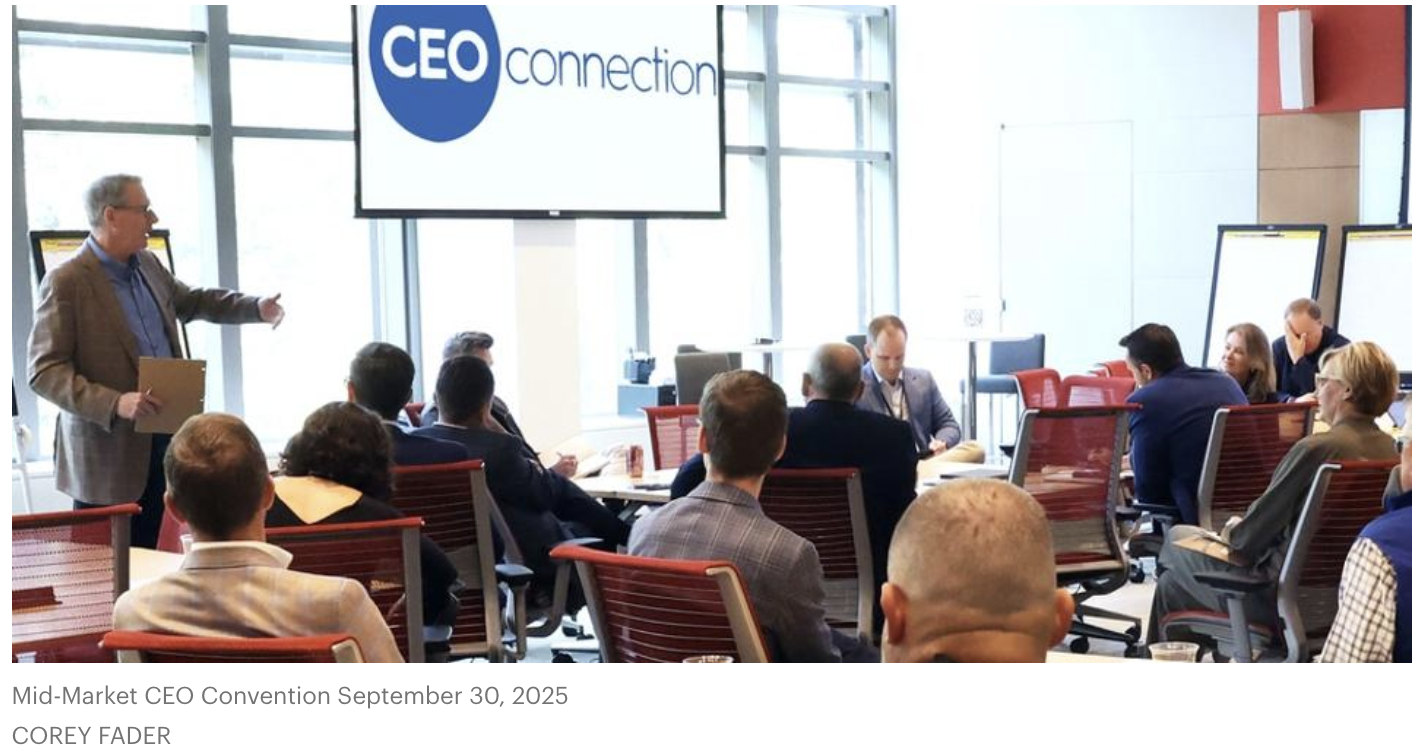
This past week over a hundred mid-market CEOs and subject matter experts gathered at GE’s former global development center, Crotonville – now called Windrose on Hudson. They shared perspectives on what’s going on in the world and discussed various topics. Perhaps most applicable to you is their insights on leading through chaos. The consensus was that CEOs must exhibit the opposite of chaos – calm – and deploy a culturally appropriate inspiring mandate, organizational vigilance, and interactive leadership.
Chaotic Times
The group applied Dave Snowden’s Cynefin framework to the world at large and realized the combination of technological change led by AI, ongoing wars, moving tariffs and other US Government actions have produced some real chaos:
- Clear (Obvious/Simple): Situations where causes and effects are well understood and universally agreed upon, allowing for repeatable best practices.
- Complicated: Scenarios where causes and effects exist but require expert analysis and evaluation, permitting multiple good practices.
- Complex: Contexts where outcomes emerge from many interacting factors and patterns are only apparent in retrospect, requiring experimentation and adaptation.
- Chaotic: Situations with no discernible relationship between cause and effect, demanding immediate action to establish order.
- Confused (Disorder): Contexts where it is unclear which domain applies until further assessment and sense-making occurs.
They also drew a distinction between chaos’ unpredictability and a crisis’ decisive turning point and moment of intense difficulty demanding immediate response. As discussed in an earlier article on crisis management, the priorities in a crisis, in order, are physical, reputational, and then financial issues and threats.
Baylin Technologies’ Leighton Carroll, suggested that the opposite of chaos is calm and that CEOs need to imbue that. Lehigh’s Scott Koewer called the group’s attention to Russ Ackoff’s systems thinking framework of react, preact, and interact, reinforced by Wharton’s Peter Fader reminding the group not to “over-react.” This gets us to the main three insights from the session:
Start with an Inspiring Manifesto
Ultimately, leadership is about inspiring, enabling, and empowering others to do their absolute best together to realize a meaningful and rewarding shared purpose. Start with an inspiring manifesto that conveys who you are, what you stand for, where you’re going, and what you won’t walk by on the way – your values. This is your North Star. Communicate it often and in many different ways. Use it to build alignment and trust. Let this guide people to control what they can control and have an optimistic view of the future.
Ensure Organizational Vigilance
The Stockdale Paradox teaches us all the value of “Unwavering faith that you can and will prevail with the discipline to confront the most brutal facts of current reality.” You can’t confront the brutal facts of the ever-changing, chaotic reality if you can’t see them. You need all to have their eyes open all the time, heads on swivel with transparent information sharing by and across everyone in the organization.
Deploy Interactive Leadership at all levels
Of course, you should plan. One CEO reminded the group of Eisenhower’s saying that “Plans are nothing. Planning is everything.” and Mike Tyson’s line that “Everyone has a plan until they get punched in the face.” Do plan. Do lay out cultural, strategic, and operational guidelines. But when your people are constantly getting punched in the face in a chaotic environment, you have to put your tactical leaders in charge so they can interact with all other leaders and continually adjust their resources to deliver the manifesto.
The Culture required to thrive in chaos
Ultimately, culture is the only sustainable advantage. If culture is the collective character of an organization, you need leaders with the courage to lead through a crisis. These CEOs had all sorts of powerful insights into nurturing the culture in their organization. Some nuggets:
- There are relatively few decisions, but many choices. Culture helps ensure people make the right choices at every level of the organization.
- Marc Bodner suggested you can drive a lot by asking “So that???” This gets at rationale and intent – doing X so that Y can happen.
- Behaviors change in response to antecedents (asking) and consequences. While you do want to reward eight times as much as you punish, Peter Fader pushed the need for “regular, rigorous, standardized assessment of values and behaviors.”
- Many found the BRAVE cultural framework helpful, looking at Behaviors, Relationships, Attitudes, Values, and Environment.
Many found the Denison cultural assessment tool useful.