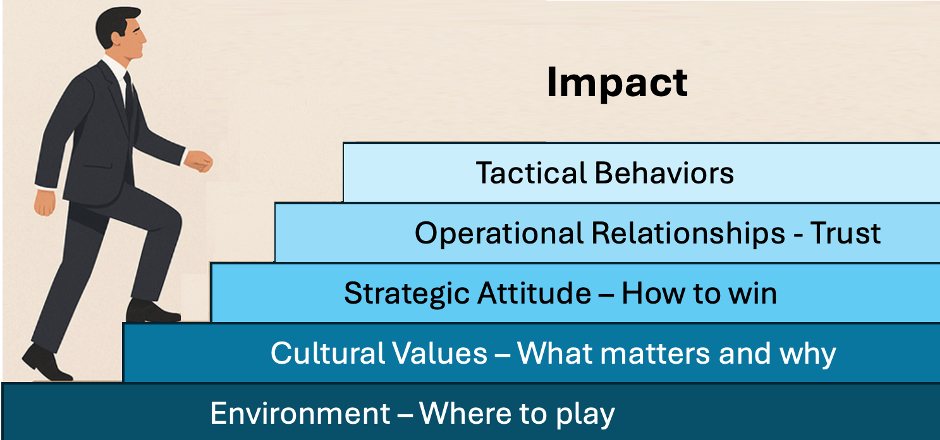
Clarify leadership roles by aligning cultural, strategic, operational, and tactical leaders with values, attitude, relationships, and behaviors respectively. This is a mashup of two frameworks – Nested leadership and BRAVE (Behaviors, Relationships, Attitude, Values, Environment.) That yields the following, all within the context of the ever-changing Environment:
- Cultural leadership is rooted in Values: Who we are and what matters and why.
- Strategic leadership is about Attitude: How to win choices nested in the culture.
- Operational leadership is about Relationships: How to connect, communicate, and build trust across business units and functions nested in culture and strategy.
- Tactical leadership is about Behaviors nested in culture, strategy, and operations, all adding up to the most important impact and results.
Cultural Leadership: Values – What matters and why
Cultural leadership is rooted in values – defining, living, and communicating “who we are” and “what matters and why” as the organization’s only sustainable competitive advantage. CEOs and top teams cannot delegate this; people need to know and be inspired by whom you stand for, why it matters, and what does not change as strategies and tactics evolve.
St. Joseph’s Hospital puts “patients first” at the core of its identity. That drives behaviors (how people act), relationships (how they interact and give credit), and their choices around whom to serve and how, explicitly tying those cultural choices to hiring, daily rituals of appreciation, and the stories people tell internally. As Procter & Gamble’s Richard Goldstein put it, “Principles are only principles when they hurt.” When you compromise on a cultural value, it stops being real.
Strategic Leadership: Attitude – How to win
Strategic leadership is about attitude – “how to win” over time – expressed in a few over-arching, well-communicated choices. As Harry Kangis put it, “Choosing not to pursue a bad idea is easy. The hard choice is not to pursue something that’s a good idea – for someone else.” Senior leaders decide where to play, where not to play, and how to allocate scarce resources to enable operational and tactical leaders.
Consumers in the UK buy more soft drinks in the summer than in the winter. Coca-Cola’s bottler built only enough capacity to supply the market in the winter. They then locked in all the available contract manufacturers to meet peak summer demand. This meant their profitability was optimal in the winter and only good enough in the summer because they had to pay the contract manufacturers, while their competitors had to build enough capacity to meet summer demand, resulting in their losing money in all but the summer months.
Operational Leadership: Relationships – How to connect and build trust
Operational leadership lives in the middle and is mostly about relationships – cross-functional coordination, communication, orchestration, and execution. Business-unit and functional leaders translate attitudes into operating models, align their peers, and make sure handoffs across the matrix work to build trust in each other’s benevolent intent, competence and capability, and consistent reliability.
One Procter & Gamble brand manager, given only a budget and deadline to get new products into test market, assembled a cross‑functional team from core functions and external manufacturing and distribution partners, co-located them in a rented townhouse in the test market, established shared communication and decision practices with joint plans and timelines, and through frequent reviews and rapid course‑corrections based on early tests turned potentially siloed functions into a tightly aligned effort that put 12 new products on shelves in under six months – faster than anyone thought possible at P&G at the time.
Tactical Leadership: Behaviors – What impact
Tactical leadership is about behaviors – what people do in moments of truth with customers, collaborators, and colleagues. Front line supervisors and team leaders convert strategies and operating plans into specific actions, choices, and responses in rapidly changing situations.
Think about a store manager on a peak holiday weekend who moves people between registers and the floor, tweaks displays, and authorizes small service recoveries so the experience stays true to the brand’s promise. That manager’s decisions nest inside cultural guardrails (what the brand stands for), strategic choices (which customers and occasions matter most), and operational routines (staffing models, inventory, and service standards), but in the moment it is those local behaviors that determine whether customers experience the culture and strategy as intended.
Bringing it together to deliver better results faster
The practical challenge – and opportunity – is to keep all nested and aligned. Cultural leaders set values; strategic leaders choose attitude; operational leaders build relationships, routines, and trust across the organization; tactical leaders drive behaviors and ensure impact and results.
Nested BRAVE leaders and their teams accelerate through points of inflection and deliver better results faster. When cultural values, strategic attitude, operational relationships, and tactical behaviors are clear, aligned, and continually evolving in the context of the ever-changing environment, what leaders and their teams say and do are consistently in sync, delivering the right impact in the right way at the right time over time.
Click here for a categorized list of my Forbes articles (of which this is #973)