Andy Grove defined a point of inflection as “an event that changes the way we think and act.” Given COVID-19’s impact, the only question is whether you’re going to lead with systemic changes in your organization, market, or industry, or follow others. As McKinsey laid out in their recent article on The Great Acceleration, “Companies that move early in a crisis to get a jump on competitors often maintain that lead for years to come.” So, lead by re-looking at your strategy, organization and operations and making appropriate changes all together, in sync, all at the same time.
Three premises:
1. COVID-19 is one of the defining moments of our time. Getting your transition right and avoiding avoidable mistakes will accelerate your organization and personal impact, effect, and trajectory. If you’re not looking at this as a point of inflection, someone else somewhere else will inflect things for you. And you may not like how that story ends.
2. Leading is different than managing. Where managers organize, coordinate and tell, leaders inspire, enable, and co-create. Be an other-focused leader, inspiring and enabling others to do their absolute best together to lead through this “great acceleration” and realize a meaningful and rewarding shared purpose.
3. Leading requires choices – and bold, decisive choices at points of inflection. Picking one over-arching strategy, aligned with one culture, organization, and way of operating seems riskier than keeping options open. But choosing to be best in class at one thing versus good enough at many can be the difference between success and failure. Pick one.
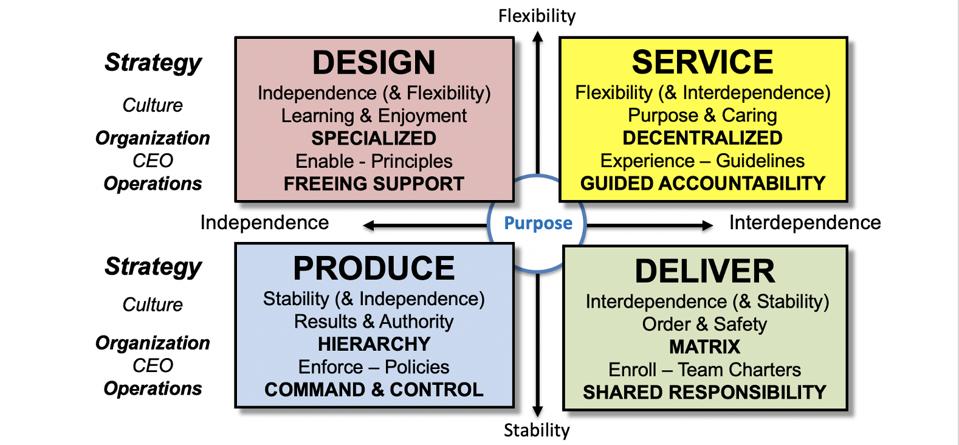
Strategic Choices
BRADTSummary chart from our book, “Point of Inflection”
Do this by working through the enduring impact of the environmental changes, re-committing to your values, and changing your attitude to inform your relational and behavioral choices.
1 Environment: Clarify Your Situation and Field of Play
Most freeze in times of uncertainty. They defer choices until things sort themselves out. As McKinsey pointed out, these organizations are going to find themselves following the leader for years to come.
Instead, lay out possible scenarios and options to deal with the different scenarios. It doesn’t matter if the scenarios are right. What matters is leveraging them to unfreeze your organization’s thinking. In general, you’ll want a base case most likely scenario, an optimistic scenario, and a pessimistic scenario.
Then assess the impact of your options under the different scenarios. Choose where to play and how to win while preserving your ability to adjust along the way.
2 Values: Align All Around the Organization’s Mission, Vision, and Guiding Principles
Your mission (why) probably won’t change.
However, this is a great opportunity to relook at your ambition and picture of success – your vision (what.)
Your guiding principles are the things you will not compromise on the way to delivering that mission and achieving that vision – values in action (how.) This is trickier. Your values probably should not change, but your change in vision may dictate a change or evolution in your guiding principles.
3 Attitude: Make Choices Around Overarching Strategy, Priorities, and Culture
This is your COVID-19 pivot point. Hopefully you’re already aligned around one single overarching strategy to drive how you’re going to win (design – produce – deliver – service.)
What changes with COVID-19 should be your resource choice priorities. Move resources from areas in which good enough is good enough into the one most important area in which you choose to be best in class as a top priority and then also to areas in which you choose to be world class.
And make sure your culture evolves in sync with those changes (independent – stable – interdependent – flexible.)
4 Relationships: The Heart of Leadership
The change in your resource choice priorities dictates a change in your organization. Do some future capability planning to determine the organization you’re going to need to accelerate. Then adjust your ADEPT components: how you acquire, develop, encourage, plan and transition talent on the way to that future state.
Throughout, know that everyone is scared. Connect with them emotionally. Lay out the rational hard facts of the situation. Then inspire the way forward.
5 Behaviors: Getting Things Done
Having done all that, follow through to ensure excellent execution focused on what creates the most value for all your stakeholders, leading with a bias to freeing support, command and control, shared responsibilities, or guided accountability as appropriate.
Click here for a list of my Forbes articles (of which this is #652) and a summary of my book on executive onboarding: The New Leader’s 100-Day Action Plan.