Strategies can be theoretically elegant and practically useless without the right tactical leaders. Too many strategic leaders assume if they just set the direction and explain it well enough, everyone will follow them and they will succeed. Wrong. The direction needs to be adjusted tactically on a continual basis – by tactical leaders who need direction, and resources, and bounded authority and accountability.
“Strategy” comes from the Greek word strategos – the art of the general – arranging forces before the battle. It’s about the utilization of all forces, through large-scale, long-range planning and development, to ensure security or victory.
“Tactics” comes from taktikos – the use and deployment of forces in the actual battle in line with strategies.
This is complicated by nested battles. One level’s strategies and tactics are the next level’s missions and strategies. Imagine for example,
- The CEO chooses to expand into South America and appoints a President of South America for their business.
- The President of South America chooses to start in Brazil and appoints a Country Manager for Brazil.
- The Brazil Country Manager chooses to build the first manufacturing plant in Portugal and ship product from there to Brazil.
The CEO never imagined building a plant in Portugal.
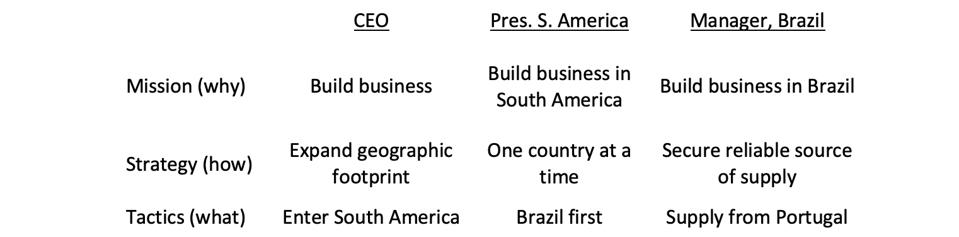
Step-down strategies
BRADTSetting up tactical leaders for success
This is a two-edged sword. A strategic leader engaging in Level Four Delegation has to give tactical leaders the direction, resources and authority they need. The tactical leader has to accept and own accountability:
- Direction/objectives/desired results/intent
- Resources (human, financial, technical or operational)
- Authority to make tactical decisions within strategic boundaries/guidelines
- Accountability and consequences (standards of performance, time expectations, positive and negative consequences of success and failure)
Let’s flesh these out.
Direction/objectives/desired results/intent
One of the classic suggestions for delegation is to delegate the what and not the how. Direction is about the what.
Give people clear direction around where play choices – the hills you want them to take. This is about making the objectives clear. Recall objectives are general things like, strengthen the brand, increase market share, or decrease spending.
Quantify those objectives, turning them into desired results – measurable goals.
And tell people how their objectives fit with others’ objectives. Intent is the key to this, linking their output to the next group’s tasks. Understanding the strategic leader’s intent enables tactical leaders to adjust along the way as they see better tactical ways to achieve that intent.
Resources (human, financial, technical or operational)
Direction is useless without resources. Make sure you’re resourcing your most important priorities with the people required for success, the financial investment the need, appropriate technical support, and operational systems and support to make them real.
Authority to make tactical decisions within strategic boundaries/guidelines
This is often the hardest piece for strategic leaders. It’s hard for them to let go of tactical decisions. But they have to. If they try to make tactical decisions regarding the use of resources in the middle of implementation, they will inevitably slow things down. These decisions have to be made by the leaders closest to the point of decision.
But not in a vacuum.
Those tactical leaders need authority to make decisions – but it should be bounded authority. Give them a framework for their decisions so they know how to think about them. Give them boundaries so they know how far they can go on their own and when they need to escalate decisions.
If you do that, you can give your tactical leaders the tactical authority they need with confidence that their decisions will fit your strategy.
Accountability and consequences (standards of performance, time expectations, positive and negative consequences of success and failure)
While direction, resources and authority can flow from strategic to tactical leaders, accountability cannot be forced. It’s only valuable if tactical leaders understand and own accountability for their tactical decisions. They need to own the standards of performance. They need to commit to time expectations. They need to be willing to accept the positive and negative consequences of their success and failure.
Click here for a list of my Forbes articles (of which this is #641) and a summary of my book on executive onboarding: The New Leader’s 100-Day Action Plan.