We all know them – those amazing people who appear to be able to see around corners. They almost always seem to know what’s coming before anyone else does and be ready for it.
Here’s their dirty little secret.
There is no magic. They just spend more time with outside-in thinking than the rest of us. They are constantly looking for potential changes and asking themselves, “What if?”
Thus, when things happen that surprise others, they’ve already thought through their options.
Outside-in thinking
Premise #1: You can’t control external events. All you can control is how you react to those events.
Premise #2: People needing to react quickly to external events have less time to think things through than those that anticipate possible external events.
Putting those together suggests you’re going to better off thinking about possible external events in advance.
The 5Cs framework is a good place to start: Customers, Collaborators, Capabilities, Competitors, Conditions
Conditions: The context in which you, your customers, collaborators and competitors work in. Look at social/demographic, political/government/regulatory, micro and macro-economic context and trends and market definitions, inflows, outflows, substitutes and trends – as well as the impact of climate change on your organization.
Ask what if some of those change in ways different than you expect.
Customers: Those that benefit from the output of your work product.
Collaborators: Those that work with you to produce or enhance the design, development, selling, distribution or support of your work product.
Competitors: Those that create anything that your customers might choose instead of your work product.
For customers, collaborators, and competitors, focus your what if questions on possible changes in their needs, hopes, preference, commitment, strategies, and price/value perspective at any stage along their chain – including influencers.
Capabilities: Your own organizational strengths that enable the design, development, selling, distribution or support/service of your work product.
Of course, everyone you offer jobs to will accept and none of your key people will ever leave. Of course, all your people will deliver on all their commitments. But, just in case, ask what if things don’t happen exactly as planned.
Range forecasting can help you understand people’s 80% confidence ranges and prepare for different scenarios. There are differences between 1) will ship on March 3 and 80% confidence ranges of 2) March 3-10 and 3) April 27-March 3.
What? So What? Now What?
Essentially, your outside-in 5Cs probing and “What if?” questions drive you to think about more scenarios, complicating your thinking by choice. The what/so what/now what framework can help you sort through that mess.
“What” generally refers to facts. In this case, it refers to the possible scenarios you’ve identified. You’re not pretending to know what’s around the corners. You’re just thinking through what could be around the corners. Get all the scenarios on the table.
“So what” generally gets at opinions and conclusions drawn from the data or scenarios. Sort through the scenarios. Do your analysis Add your insights. Determine which scenarios to prepare for and which to ignore.
Here’s where the “How stupid would we feel?” question comes in to play. Ask how stupid you would feel if each scenario came to pass and you weren’t ready. Then focus on the ones that would make you feel most stupid if you did not prepare.
“Now what” turns those opinions and conclusions into potential actions. This is how you get everyone ready to react to the most important scenarios. All should know what to do if those scenarios play out so they can move directly to action.
In many ways, the difference between a crisis and an opportunity is how well you’re prepared to deal with it. Victims get surprised and can’t react. Not you. You’ll be ready to lead the way forward.
Take a strategic approach to risk management, mapping changes on a major vs. minor and temporary vs. enduring axes and then downplaying minor & temporary changes, evolving through minor & enduring changes, managing major & temporary changes, and hitting restarts for major & enduring changes.
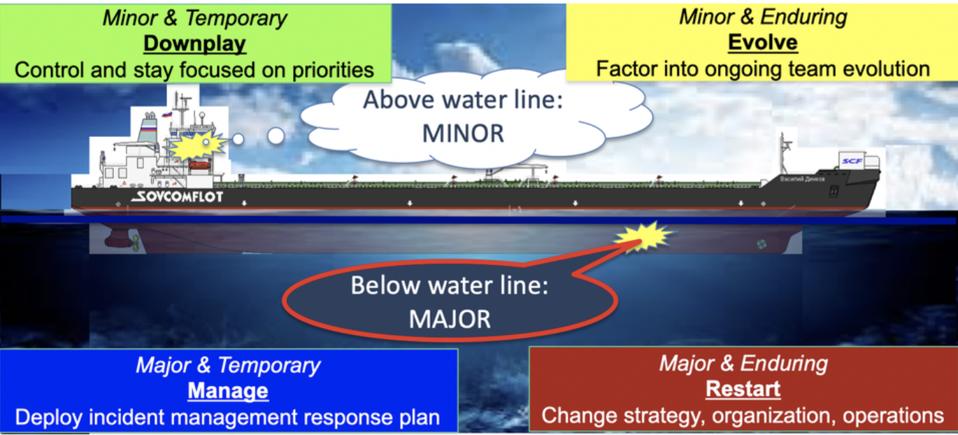
Risk Management
BRADT
For major & temporary changes, deploy your incident management response plans that you prepared in advance. The reason you prepared is so that you all can react quickly and flexibility to the situation you face. Don’t over-think this. Do what you prepared to do. Then bridge situational gaps to respond even better and learn from what happened to prepare even better for whatever comes around the next corner.
Click here for a list of my Forbes articles (of which this is #610) and a summary of my book on executive onboarding: The New Leader’s 100-Day Action Plan.