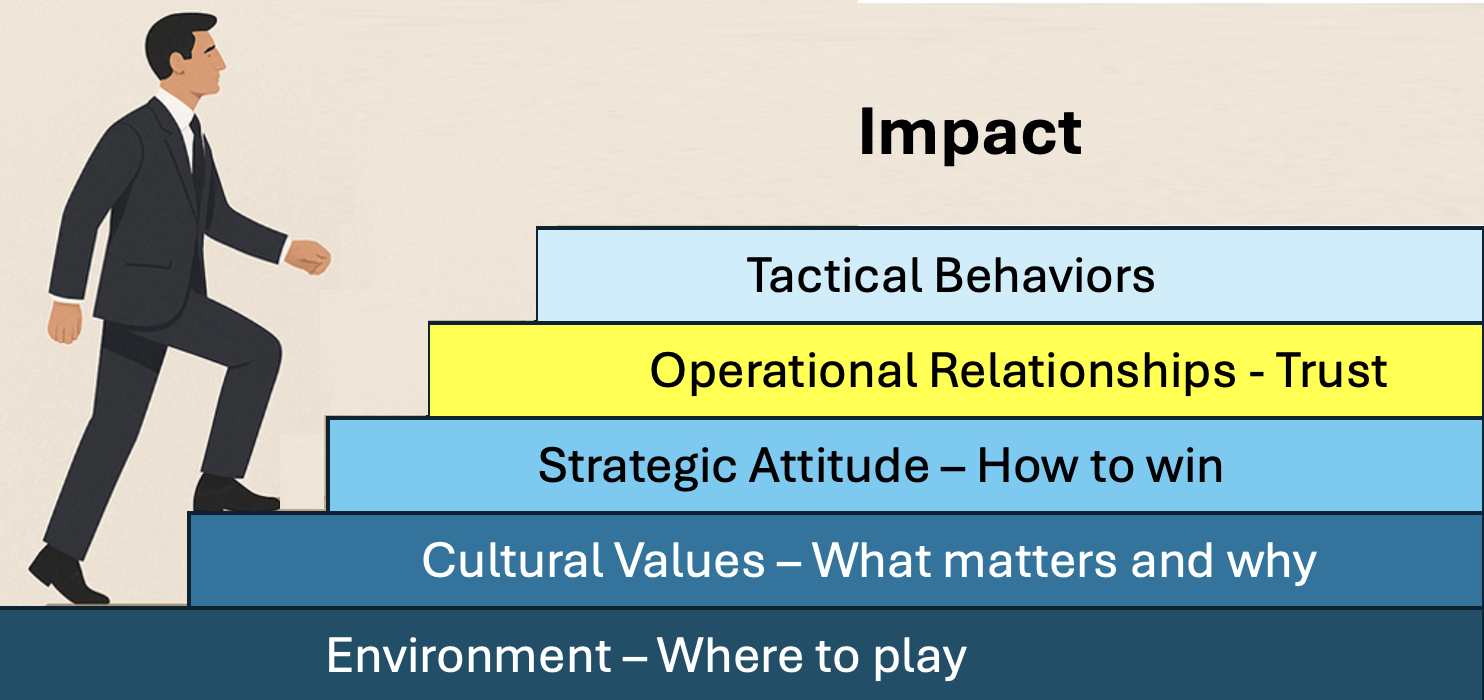
Middle managers play a pivotal role in organizational success through the quality of relationships they foster across functions, geographies, and levels. Rather than just “running the middle,” their true contribution is leading operational relationships – connecting culture and strategy to front-line behaviors.
Operational Leaders at the Center
As discussed in last week’s article on Forbes.com, in a BRAVE nesting of leadership, cultural leaders set values, strategic leaders shape attitude, operational leaders steward relationships, and tactical leaders drive behaviors. Operational leaders sit in the middle, bringing alignment, coherence, and collaboration to everything above and below.
Their ability to make strategic vision real comes from translating the “how we win” of leadership into the “how we work together” of daily execution, perhaps using Jeff Scott’s old mantra of “You guys decide what we’re working on and we decide how we do it.”
When operational management is effective, marketing, sales, product, operations, finance, HR, headquarters, and the field collaborate seamlessly. When it breaks down, friction and silos take over.
What Great Operational Relationship Leadership Looks Like
Excellent middle managers behave like chief relationship officers for their realm. They deliberately invest time in building trust upwards with senior leaders, downwards with teams, and laterally with peers. This focus goes far beyond managing tasks or metrics – it is about connecting people who otherwise might collide.
Imagine a business-unit leader guiding a major launch. She brings key players – such as marketing, supply chain, and finance – into a shared rhythm with cross-functional planning, joint reviews, and clear decision rights. Making dependencies visible (for example, what marketing needs from supply chain by when), she clarifies not only what needs to be done, but why it matters. She communicates intent and trade-offs, surfaces risks with options rather than complaints, and is visible collaborating with peers across functions and geographies.
This approach produces:
- Fewer surprises, thanks to shared expectations.
- Faster problem-solving, as issues are flagged in trusted forums.
- Higher engagement, because people sense they are part of an integrated, purposeful team.
When Middle Managers Get It Wrong
Operational relationship failures rarely appear first as overt conflict; instead, they show up as missed numbers, rework, or churn. Most problems stem from one of three common failure modes:
- The Siloed Translator: Focused only on “my team and my metrics,” this manager attends cross-functional meetings merely to report (not to align), pushes down tasks without context, and raises complaints without ownership. They appear defensive, causing peers to work around them and eroding trust.
- The Overloaded Firefighter: Caring and hard-working but unable to say no, they promise everything to everyone and then try to deliver through sheer effort. By failing to align expectations, every project feels chaotic and unreliable, though intent is never the issue – relationship leadership is.
- The Passive Conduit: Passing messages up and down without insight or critique, they never challenge unclear direction, negotiate realistic trade-offs, or convene stakeholders to resolve tension. Their teams are whipsawed by shifting priorities, and informal (often toxic) power structures rise to fill the vacuum.
How Middle Managers Can Step Up
Middle managers committed to making a difference can focus on three essential shifts:
- Reframe the job: Move from owning a function to owning relationships. Ask, “Which key interfaces am I strengthening this week?” not just “What is my team delivering?” Visibly map critical dependencies and create explicit operating rhythms with other functions.
- Lead with trust: Clarify intent with peers, communicate what you’re solving for, where you’re flexible, and where you’re not. Consistently follow through, communicate alternatives when commitments slip, and share context so others appreciate your constraints. Trust is built in small, repeated acts.
- Integrate up and down: With senior leaders, bring advance warnings with options—not just problems. With teams, make strategy tangible by connecting it to concrete decisions. Use every staff meeting to align across functions, so all see the bigger picture—not just their silos.
Why This Matters More Now
As organizations become more matrixed, virtual, and project-based, truly critical work rarely stays within a single function. It moves through handoffs, time zones, and people who may not share the same boss or office. In this environment, middle managers who lead operational relationships are the glue holding strategy, culture, and execution together.
Strong operational relationships make culture and strategy visible as real behaviors—building trust, driving alignment, and enabling results at the front line. When those relationships falter, even the best-laid strategies and cultures remain theoretical, never reaching execution.
Every middle manager faces a fundamental question: Am I simply overseeing tasks in my lane, or am I leading the relationships that turn values and strategy into real-world impact? The answer determines whether your organization achieves coordinated excellence or lingers in disconnected effort.