Organizing concepts are the connectors between your thinking and strategy and what you’re trying to communicate. They help interviewers remember your most relevant strengths, motivation and preferences. They help you position yourself in others’ minds as an executive onboarding into a new role. And they make it easier for others to follow your lead in accelerating through points of inflection.
I originally wrote about this the morning after the Democratic Presidential debate in Las Vegas. The difference between those that had clear organizing concepts like Bernie Sanders relating everything to justice for all and Elizabeth Warren fighting corruption in any form and the others who seemed to be trying to shoehorn disparate messages into the conversation was striking.
After today, we may have more clarity, with Sanders still focused on justice for all, Biden focused on decency and honor, and Bloomberg focused on competence. (There’s another article begging to be written about which of those is more inspiring – perhaps after today’s results are in.)
Interviews
There are only three interview questions: Will you love the job? Can you do the job? Can we tolerate you? At the same time, interviewers don’t care about the people they are interviewing. They only care about what those people can do for them and their organizations.
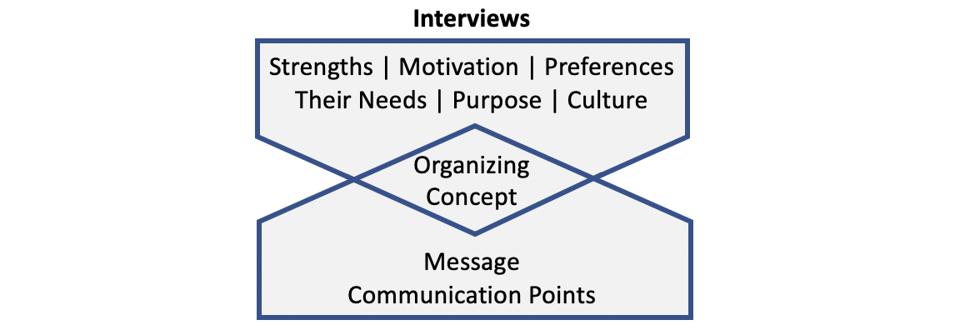
Interviews
BRADTThus, interviewing is about the candidate’s ability to connect their strengths, motivation and preferences with the organization’s needs, purpose and culture. The most successful interviewees, like the most successful politicians, are more focused on delivering the right message than on specifically answering the exact question asked. As discussed in my article on acing the only three interview questions, this requires pausing to think, answering the question asked briefly, and then bridging to the right message.
An interviewee’s organizing concept helps them know which bridges are most important and helps the interviewer emerge with a cohesive picture of the person they are interviewing that they can explain to others – something like: “X is the right candidate. They perfectly blend a passion for our cause with the strengths and personality to make them successful.”
Executive Onboarding
Just as there are only three interview questions, anyone meeting an executive onboarding into a new role has only one question: How is this new executive going to impact me?

Executive Onboarding
BRADTExecutives successfully navigating the eight essential steps of executive onboarding will have thought through the context, culture and risks they face to determine the right approach for their onboarding. They will have landed on an organizing concept to guide their initial message and communication points.
The tricky piece is that as they are converging into the organization before trying to evolve it, they can’t have a point of view. Any idea they espouse before they’ve done the right amount of listening and learning will inevitably and correctly be perceived as not invented here. By espousing any idea, they are saying they don’t care what others think.
Thus, early on, a new leader’s organizing concept guides their own questions, not answers. Everything communicates: what new leaders say and do and don’t say and don’t do, including the questions they ask – like “How do we stay ahead of the curve?”
Leading Through a Point of Inflection
Change is scary. People facing change have the same question they have when dealing with a new leader: What does this mean for me?
Those leading organizations to accelerate through strategic points of inflection have to jump-shift their strategy, organization and operations all at the same time. They got to this point because of a change in their situation or ambitions and need to translate their situational understanding into a strategic focus, message and communication points.
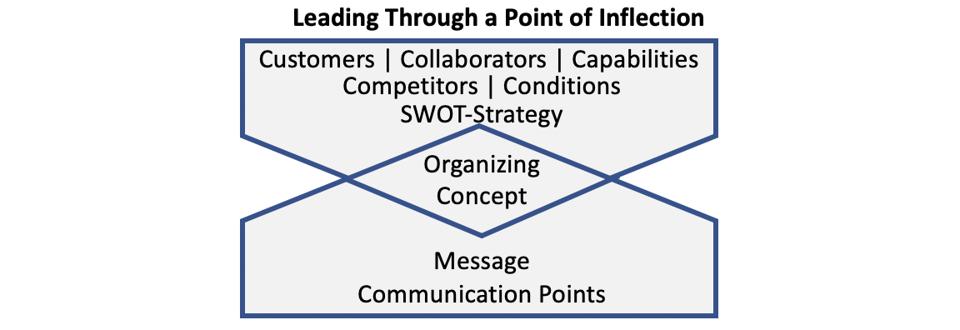
Point of Inflection
BRADTThere can be an overwhelming amount of information for anyone to take in. An organizing concept focuses everyone on the most important ideas. It gives them a lens to filter and view customers, collaborators, capabilities, competitors and conditions on the way to building a differentiated strategic advantage. It helps them see how the culture, organization and ways of working have to change – like Jack Welch’s organizing concept in his early days as CEO of GE: Be #1 or #2 in every segment or get out.
Click here for a list of my Forbes articles (of which this is #622) and a summary of my book on executive onboarding: The New Leader’s 100-Day Action Plan.