As described in my earlier article on What It Takes To Accelerate Through A Stategic Inflection Point, if there is a change in your situation or your ambitions, you need to jump-shift your strategy, organization and operations all together, all at the same time. There are four primary areas of strategic focus: design, produce, deliver, and service. The choice of which of those areas on which to focus dictates your organizational and operational choices.
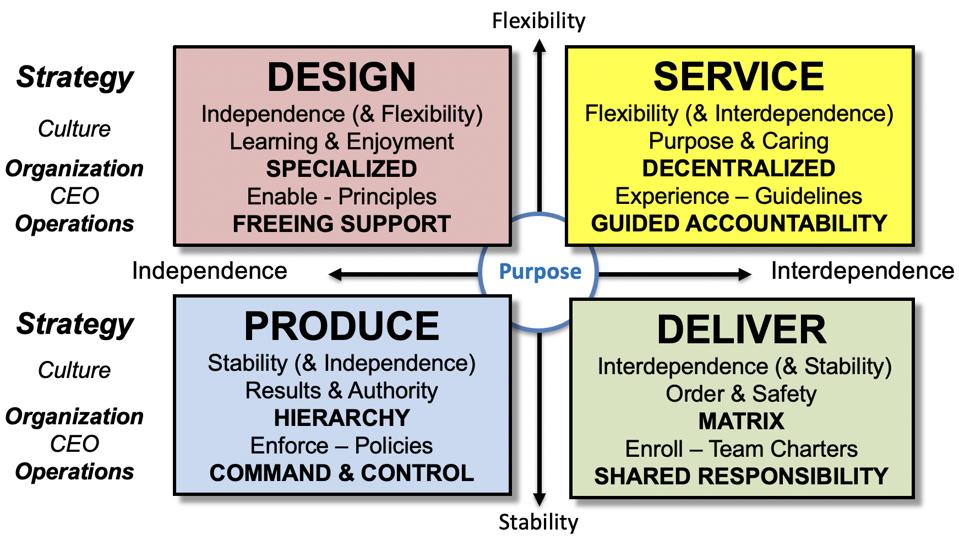
POI Framework
BRADT
This article is the first of four and will take you through how to win with a design-focused strategy. The other three focus on production, delivery and service.
To focus on design is to create, adapt or arrange something new.
- Create things that did not exist before and are new to the world.
- Adapt things that did exist, modifying them to make them fit for a new use.
- Arrange things by putting them into “proper order or into a correct or suitable sequence, relationship or adjustment” so the new whole is greater than the sum of the parts.
Value is defined as the customer’s view of the relation between your perceived, relative benefits and your perceived, relative costs.
- Design-focused organizations win by imagining new valuable things.
- Production-focused organizations win by making valuable things out of disparate elements.
- Delivery-focused organizations win by conveying valuable things from one party to another.
- Service-focused organizations win by valuably enhancing their customers’ experiences.
While most organizations do some level of design, production, delivery and service, and all must market and sell, the most successful organizations have a clear focus on one of the first four areas.
Design Culture
A design-focused organization’s main cultural driver should be independence. Its designers should feel free to get their inspiration from anywhere they can. Flexibility, learning and enjoyment support that. But independence rules.
Specialized Organization
A specialized organizational structures work especially well in design-focused organizations. Designers and inventors have special and often rare strengths. The rest of the organization has to nurture and protect them, minimizing unproductive distractions so they can spend their time creating, adapting and arranging.
CEO as Chief Enabler
In an organization basing its success on its ability to nurture and protect its designers, the CEO has to be the chief enabler. Great leaders bring out others self-confidence. They do this in large part by emphasizing confidence-building in their approach to the direction, authority, resource, and accountability aspects of delegation. This is especially important when it comes to designers.
Direction. Emphasize the problem you need solved or the opportunity you can take advantage of. Then, give them as much freedom as you can about how they solve it. The more they can think with the mind of a child, the better.
Authority. Give them the authority to experiment. By definition, the “new” won’t match what you currently have and do. Note the authority to experiment is not the authority to implement.
Resources. This one is counter-intuitive. But adding constraints increases innovation. Think in terms of scope, time and resource constrained creative sprints instead of never-ending quests.
Accountability. The key here is assuming success. Have confidence in your designers. Recognize and reward them for their achievements at the end of creative sprints along the way to bring out their self-confidence.
Operate with Freeing Support
Design behavior is fragile. All need to give it freeing support to keep it going. The ABCs of changing behavior apply.
The antecedent is prompting designers to create, adapt and arrange as part of your approach to delegation. Assuming you’ve got the right people with the right direction and support, they are likely to do what you asked them to do.
The trap here is consequences, and especially unintended negative consequences for positive behavior. Make sure you and everyone interacting with your designers are:
- Positively reinforcing desired behavior (creating, adapting, arranging.)
- Punishing undesirable behavior (outside acceptable norms.)
Change the way you:
- Positively reinforce undesirable behavior
- Punish desired behavior (by applying others’ standards to their output.)
You may have success by leading with principles (as opposed to more rigid policies or more directional guidelines.) Principles help people come to their own decisions in a way that fits your vision and values.
Click here for a list of my Forbes articles (of which this is #603) and a summary of my book on executive onboarding: The New Leader’s 100-Day Action Plan.