[et_pb_section fb_built=”1″ _builder_version=”3.22″][et_pb_row _builder_version=”3.25″ background_size=”initial” background_position=”top_left” background_repeat=”repeat”][et_pb_column type=”4_4″ _builder_version=”3.25″ custom_padding=”|||” custom_padding__hover=”|||”][et_pb_text _builder_version=”3.27.4″ link_option_url=”https://www.forbes.com/sites/georgebradt/2019/06/04/get-an-early-read-on-how-your-new-boss-manages/#72c0033a4056″ link_option_url_new_window=”on”]
The good news is that Millennials are motivated by the same basic benefits ladder as others. The twist is that there are three sub-steps to the top step. In terms of basics, think features and benefits laddering up to rational benefits leading up to emotional benefits. For Millennials, then think in terms of good for me, good at it, and good for others.
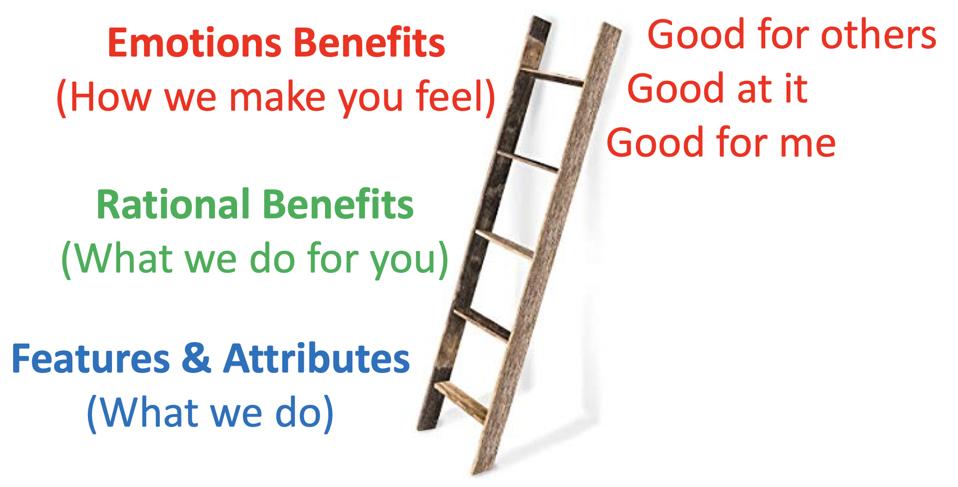
Millennial Benefits Ladder
Features and Attributes
Features & attributes describe the product or service itself and what it does. For example, a water bottle made from corn might be described as
- Containing water with an
- Easy-open cap and
- Made from corn (and not plastic)
Rational Benefits
Rational benefits are what the product or service does for its users. Sticking with our water bottle, these might include:
- Refreshes you
- Conveniently in an
- Environmentally friendly way
Emotional Benefits
Emotional benefits are the answer to, “How does that make you feel?” Ultimately, all benefits are emotional and the most important emotional benefits make you feel something yourself, especially happiness in all its guises.
Here’s where the Millennials are different. (At least for the moment. It’s not yet clear if they’ll stick with this through their various life stages.) Many of them are driven by purpose. This means there’s a hierarchy of goods.
As I’ve written before, happiness is good. Actually, it’s three goods: good for me, good at it, and good for others. For Millennials, good for me is the first rung of emotional benefits. Good at it is the second. And good for others is the top rung.
Going back to the water bottle example and how it makes Millennials feel:
- Good for me is about feeling revived yourself.
- Good at it is about feeling ready to tackle the next task.
- Good for others is about feeling like you’ve done your part for the planet.
Interviewing
Remember this when you are being interviewed by Millennials. In any case, the single most important thing to keep in mind in a job interview is that it’s not about you. As I’ve written before, no one interviewing you cares about you. They care about what you can do for them.
Crossing that idea with the Millennial Benefits Ladders looks like this:
The bottom rung of features and attributes are accomplishments and strengths – what you’ve done and what you do.
The next step of rational benefits is about the fit between those strengths and your preferences with the organization’s needs and culture – what you can do for them.
The top rung of emotional benefits, how you make them feel, has three levels: good for me, good at it, good for others.
Good for me is about solving your interviewer’s most pressing problem. Believing you can do that will make them feel relieved themselves.
Good at it is about bringing new capabilities to the interviewer’s organization. Believing you can do that will make them feel like they have contributed to their organization.
Good for others is about your motivation to help those the organization wants to help. Believing that will lead to an emotional connection with the interviewer. If you do that, you’ll get the job. This is so important, don’t be surprised if it’s a Millennial’s first question in a job interview.
Executive Onboarding
The first of the eight essential steps of executive onboarding is positioning yourself for success in your new job. A big part of this is getting your message right. The same logic applies to this in general and when working with Millennials:
Starting by telling them about your history, strengths, ways of leading and the like is focusing on your features and attributes. No one cares. It’s counter-productive.
Focusing on the rational benefits you bring to the party and what you can do for them is better. But not good enough.
Instead, focus on the top rung of the Millennial Benefits Ladders – how you’re all going to do good for others and how you all should feel about that. Show them you care about what they care about.
Click here for a list of my Forbes articles and a summary of my book on executive onboarding: The New Leader’s 100-Day Action Plan.
[/et_pb_text][/et_pb_column][/et_pb_row][/et_pb_section]