Barnard and Radcliffe were the women’s colleges most closely aligned with Columbia and Harvard respectively. When they were founded there were no good educational opportunities available to women. Today there are. In light of that, Radcliffe has merged with Harvard and effectively ceased to exist. On the other hand, Barnard has stayed separate with a strong working alliance with Columbia. What Barnard did, and we all should do, is appreciate the past, look outward and focus forward.
Today’s Barnard is a small, women’s liberal arts college that is both independent and affiliated with Columbia in New York City. Its president, Debora Spar, told me that this is the best of all worlds. Barnard’s size – 2400 students – allows for small, intimate classes and direct interaction between teachers and students. Its independence allows it to chart its own course, while its affiliation with Columbia means that its students can take full advantage of Columbia’s resources and are granted Columbia degrees. Finally, its location makes it both secure on its campus and fully a part of all that New York City has to offer.
From no choices for women
Barnard was founded in the 1880s by a “small group of determined women” who were not allowed at the all-male universities of the time. They couldn’t attend lectures. They couldn’t get degrees. They did not have the choices available to them that men had.
To a wide range of choices
Now women are accepted at those formerly all-male universities. And 98% of women college graduates made that choice. Those that attend Barnard do so not because they don’t have other good choices, but because Barnard is the right choice for them.
From low awareness
Spar suggests that Barnard is the “best college for women in the world”. Given its strengths you would think women would be falling over each other to get in, philanthropists would be competing to make their mark on the school, the community at large would be begging Barnard for leadership. Spar thinks they would – if they knew about the benefits of a Barnard education. According to Spar, most students come to Barnard in spite of its status as a women’s college; by the time they leave, they’ve become devotees to single-sex education. Spar is on a mission to help others discover the “special sauce” that has converted so many graduates.
To building a presence
Spar is focused on strengthening Barnard’s core, community and communication.
Strengthening the core involves adding new buildings, new centers for research and leadership studies, and new programs.
Strengthening the community involves expanding the social, geographic, ethnic, economic and racial diversity of the student body, building the endowment, further strengthening the faculty.
Strengthening communication means expanding Barnard’s presence in its local and metropolitan communities, impacting women’s learning around the world across the three types of leaders the world needs: artistic, scientific and interpersonal.
What got us here may not get them there
Most successful organizations begin by solving a previously unsolved or poorly solved problem. Success is born of differentiation. The only way to compete with parity products or services is by reducing some aspect of your costs. Unfortunately, the ultimate way to do that is by going out of business. Competing by creating new or more value allows all to share in that value creation.
The trouble is that differentiation is fleeting. Build a better mousetrap and they will beat a path to your door: some to buy your mousetrap and some to figure out how you did what you did in order to copy or better you.
This is what happened to Radcliffe College. Once Harvard accepted women, they no longer needed Radcliffe. Now Radcliffe exists only as an institute to “support creative work in all disciplines”. This would seem to be the polar opposite of differentiation and far less valuable than striving to be the “best women’s college in the world”.
A path forward
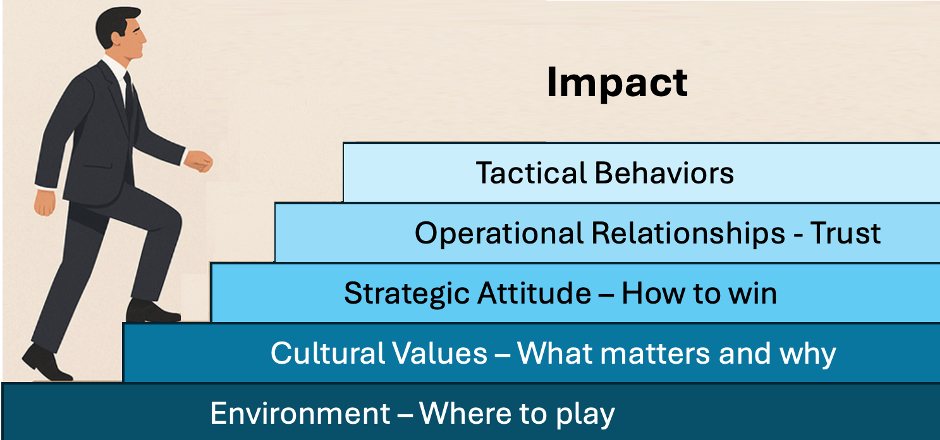
Appreciate the past. Understand what got you here and why. It is the context for all you do and how your values were formed.
Look outward. Look outside the organization to understand how the world is changing – and what new problems need solving.
Focus forward. Leverage your existing strengths to solve new problems while building new strengths for the next step.