Leadership transitions are rarely about failure.
They’re about timing.
They’re about trajectory.
And they’re about whether an organization believes its next chapter requires a different kind of leadership than the one that brought it this far.
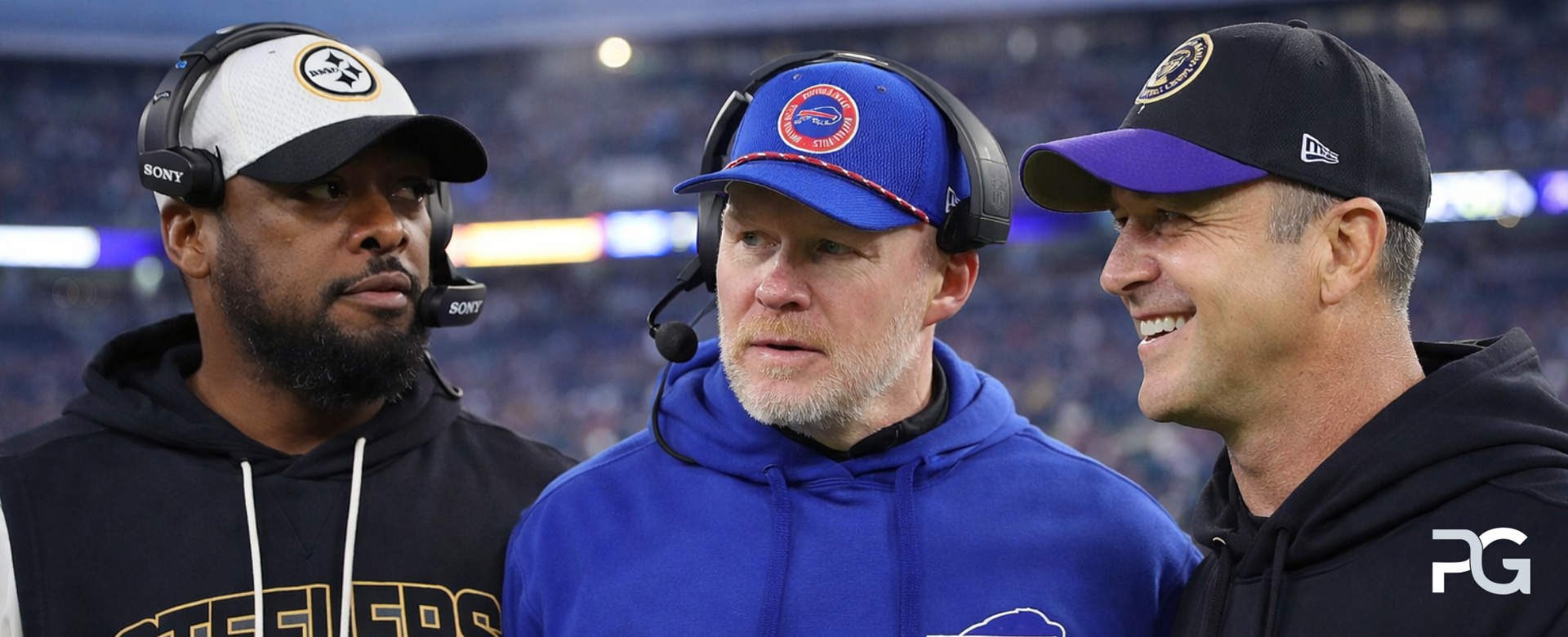
That reality came into sharp focus recently when three of the NFL’s most respected, long-tenured coaches exited their roles:
- John Harbaugh was relieved of his duties by the Baltimore Ravens
- Mike Tomlin resigned from the Pittsburgh Steelers
- Sean McDermott was fired by the Buffalo Bills
Three different exits.
One shared question:
Has continuity quietly become constraint?
When viewed through research from leading experts such as PrimeGenesis, Heidrick & Struggles, and McKinsey & Company, these decisions look far less reactive—and far more deliberate—than headlines suggest.
WHAT LEADERSHIP RESEARCH CONSISTENTLY SHOWS
PrimeGenesis, which has studied thousands of CEO and C-suite transitions, makes a critical observation: most leadership transitions fail not because the leader lacks capability, but because the organization misreads the moment.
McKinsey reinforces this idea, noting that leadership effectiveness is deeply contextual. The capabilities that drive success in one phase of an organization’s life cycle are often not the same capabilities required in the next.
Heidrick & Struggles goes further: the riskiest transitions don’t follow collapse. They follow long periods of “good enough” performance.
WHEN MOVING ON IS THE RIGHT DECISION
None of these exits were triggered by chaos. Each organization remained competitive. Each leader was respected. Each culture was intact.
But leadership research points to three moments when transition becomes necessary.
- When performance plateaus become structural
PrimeGenesis describes a subtle but dangerous inflection point: when results stop progressing and start repeating. Winning becomes predictable. Improvement becomes incremental. Breakthroughs disappear. At that point, leaders often shift—unintentionally—from architects of the future to custodians of the present. For the Ravens and Bills, sustained competitiveness without postseason breakthroughs suggested that incremental change was no longer enough. With two MVP quarterbacks in Lamar Jackson and Josh Allen, the question ownership was forced to answer the question of if their leadership was helping or hindering the maximization of the extraordinary talent it had attracted and retained over the years. In football, like most sports, the patience of losing wears thin after a few years, particularly when the talent exists to achieve the ultimate goal of winning a championship.
- When the next phase requires different leadership muscles
Leadership is phase-specific. Building, scaling, sustaining, and reinventing demand different instincts, risk appetites, and decision speeds. Tomlin’s resignation reflects an under-discussed form of leadership maturity: recognizing that the organization may benefit from a different voice and energy, even if the current leader is still effective. Knowing when you are no longer the best fit is not weakness. It’s governance at its best. Heidrick & Struggles’ research on long-tenured leaders consistently shows that effectiveness can decline not because leaders change, but because the organization does. Tomlin may have made his decision based on his own desire to take a mental break or he could have seen the writing on the wall of a Steelers team that had been over achieving with an aging quarterback whose future was also uncertain. Whatever was his mental calculation, Tomlin’s decision ultimately put the best interest of the team first, which by modern day standards is a rare act. Instead of thinking I will keep this top job until I am told to leave, he decided I will leave in order to keep this organization fighting for a top spot.
- When belief, not effort, begins to erode
One of PrimeGenesis’ most important insights is this: transitions often happen when belief changes, not when effort declines. Teams may still respect the leader, they may still work hard, but they quietly sense the ceiling has been reached. Once that emotional inflection point passes, leaders must expend exponentially more energy to generate the same momentum. That’s usually when boards act. In all three cases of Harbaugh, Tomlin and McDermott were in many ways a victim of their own success. Harbaugh was a Super Bowl champion with the best winning record in Ravens history. Tomlin never experienced a losing season and his primary weakness was not winning a playoff game (something most coaches would die to reach), and McDermott also consistently had taken the Bills to the threshold of greatness but could not reach the summit. As a result of the high achievement and resulting higher standards, ownership had lost confidence in their ability to take their teams to the next level. As a result, in their mind, it was time for a change.
WHEN MOVING ON IS NOT REQUIRED
Both McKinsey and PrimeGenesis are clear on this: changing leaders is not a cure-all.
Moving on is not required when the problem is execution, not leadership; when systems, decision rights, or talent structures are the real constraints; or when the organization is reacting emotionally rather than strategically. PrimeGenesis warns that replacing the leader without fixing the system simply transfers the problem to the next person. That is the fastest way for how leadership transitions fail.
THE THREE QUESTIONS THAT SHOULD DECIDE IT
Before any owner, board or executive team moves on from a leader, they must answer three questions honestly:
- Is the organization entering a fundamentally new phase?
- Has adaptation slowed even if performance remains strong?
- Are we prepared to support the next leader, or are we just changing the face at the top?
If those questions aren’t answered clearly, transition becomes theater, not strategy.
THE REAL LEADERSHIP LESSON
Here’s the hardest truth for organizations to accept: You can honor a leader’s legacy and still decide it’s time to move on. Harbaugh, Tomlin, and McDermott didn’t fail, they simply completed chapters in their storied careers. And as leadership research reminds us, transitions aren’t endings, they are accelerators when handled deliberately.
In football, business, and life, the question is never:
“Has this leader been good?” It’s:“Is this the leader our next chapter requires?”
That distinction is where leadership maturity lives, and hopefully a Lombardi Trophy or two as well.
References
PrimeGenesis – Why Leadership Transitions Fail
PrimeGenesis – Leadership Transition Insights
Heidrick & Struggles – Why Leadership Transitions Fail
Heidrick & Struggles – CEO Acceleration & Integration
McKinsey & Company – Starting Strong: CEO Transitions as Renewal