- Follow the Leader (Photo: Tom Grundy)
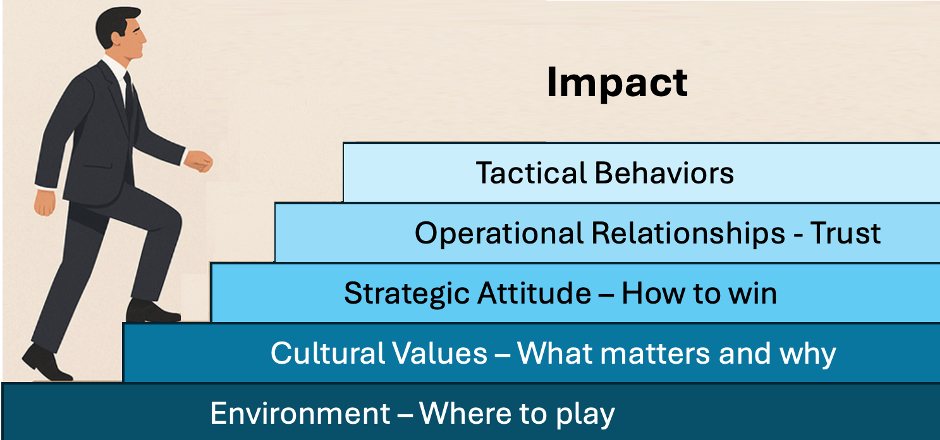
People follow charismatic leaders for a time. But they devote themselves over time to the cause of a BRAVE leader who inspires and enables them in the pursuit of that cause. BRAVE leaders have the courage to accept that leadership is not about them, but rather about working through Behaviors, Relationships, Attitude, Values and the Environment to inspire and enable others to do their absolute best together to realize a meaningful and rewarding shared purpose.
BRAVE: Behaviors, Relationships, Attitudes, Values, Environment
Environment sets the context for everything else in terms of where you are playing.
Values are the bedrock of a high performing team. Get clear on what really matters.
Attitude encompasses strategic, posture, and culture choices around how to win.
Relationships are the heart of leadership. If you can’t connect, you can’t lead.
Behaviors are the actions that make real lasting impact on others.
BRAVE leaders should think in terms of aligning people, plans, and practices around a shared purpose. In that light, environment is about context. Values are about purpose. Attitude is about the strategic process. Relationships are about the organizational process. Behaviors are reinforced by the operational process.
Environment: Get Clear on Your Mission and Fields of Action – One of your most important choices is where to play. Understand the context in which you’re operating and interpret and create the context for your team. The context includes both what others have decided for you and the choices you and your team get to make. Today’s environment is highly uncertain in exciting and dangerous ways. So be sure to consider all the risks and opportunities both outside and inside your field of endeavor and organization. Understand the business and competitive environment, organizational history, and recent results.
- Align around an interpretation of the situation assessment.
- Make clear choices around where to play and where not to play within your context.
Values: Align Yourself and Your Team with the Organization’s Mission, Vision, and Values – More or Less – Virtually every long-serving leader says that the #1 job of a leader at any level is to own and drive vision, mission, and values. Clarify what matters and why – the value you and your team create, and the drivers and principles you choose to follow within the context of the overall organization. All too often, this exercise is overlooked. Don’t fall into the bad management trap. Just because your previous managers did not do this, does not mean you should skip it as well.
- Align on a shared purpose: vision, mission, values as the foundation for all that follows.
Attitude: Make Crucial Choices around your Team’s Strategy, Posture, and Culture – Strategy, posture and culture comprise the pivot point between environment and values and relationships and behaviors. Decide how you are going to fulfill the mission you’ve been given – how you are going to win. To change your organization’s behaviors and relationships, change its attitude. Make choices around strategy (which may be someone else’s sub-strategy) and then be sure your posture and culture are in sync with those choices.
- Clarify strategy, posture, and culture to guide relationships and behaviors.
Relationships: The Heart of Leadership – Everything you do and don’t do, say and don’t say, listen to and observe communicates – 24/7, forever. This is the heart of leadership. Inspiring and enabling others is all about relationships.
- MAP your communication: Message, Amplifiers, Perseverance.
- Build an ADEPT team by Acquiring, Developing, Encouraging, Planning, and Transitioning talent over time.
Behaviors: How You Get Things Done Through Other People – Environment, values, attitude and relationships all inform behaviors and what impact you and your team make. It’s all theoretical gibberish until you put it into action. Remember that activity is not the same as impact. So focus everyone on those few behaviors with the greatest impact.
- Focus the team on what creates the most value for your team’s internal and external customers across the value chain: Design – Build – Sell – Deliver – Support[2].
Different leadership for different situations – Different situations need individual leaders, groups, or teams. As Jon Katzenbach has described, high performing teams require shared purpose, shared goals, complementary strengths, and mutual accountability/interdependence. Ask if you need a team? If so, what type? Start-up? Extended family? Hierarchical? Be clear.
Leaders are defined by their followers. The only way to achieve your vision, in line with your values, in the context you choose, is through the attitude, relationships, and behaviors you model and engender in your followers. It’s not about you. It’s about your cause. It’s not enough to have compliant followers, doing what they must. It’s not even enough to have contributing followers. You need followers committed to a deserving cause. Be BRAVE yourself and help them be BRAVE individually and together in a winning BRAVE culture.
Learn about our BRAVE Leadership talk
[1] This is an adapted excerpt from First-Time Leader (Bradt & Davis, Wiley 2014). While the book itself is geared to people going into their first leadership role or starting up new teams, this piece on BRAVE leadership has applicability to leaders at any level.